


Bloodvessels Of Upper Limb: Veins
Description
This section is from the book "Lessons on Massage", by Margaret D. Palmer. Also available from Amazon: The Book Of Massage: The Complete Stepbystep Guide To Eastern And Western Technique.
Bloodvessels Of Upper Limb: Veins
The deep veins accompany their respective arteries, and are called by their names. The superficial are the following : the radial veins on the outer border ; the anterior and posterior ulnar on the inner border ; and the median vein on the front of the forearm.
The median vein begins in the thumb, passes up the middle of the forearm to the bend of the elbow, where it is joined by the profunda vein, which conducts it to the deep veins of the forearm. The median then divides into an inner branch, the median basilic, and an outer branch, the median cephalic.
The radial vein begins in the dorsal aspect of the first interosseous space, and passes up the outer side of the forearm, turning forwards at the elbow-joint to join the median cephalic, and form the cephalic vein.
The cephalic vein passes up the outer side of the biceps muscle, piercing the fascia at the insertion of the deltoid •muscle and finally opening into the axillary vein.
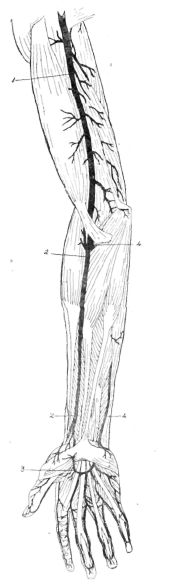
Fig. 40.—Arteries of the Upper Limb.
1, Brachial artery ; 2, radial ; 3, palmar arch ; 4, ulnar artery.
Fig. 41.—Veins of Upper Limb (Superficial).
1, Median vein; 2, radial; 3, median cephalic ; 4, anterior ulnar; 5, posterior ulna; 6, median basilic ; 7, basilic ; 8, cephalic.
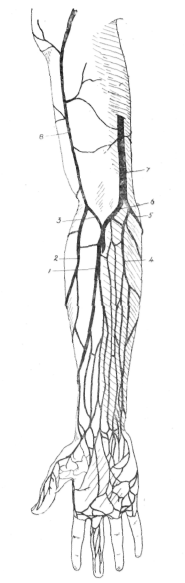
The anterior ulnar vein begins in the ball of the little finger, and ascends the anterior surface of the ulnar border of the forearm.
The posterior ulnar begins on the back of the hand in the fourth interosseous space, and proceeds up the posterior aspect of the ulnar border of the forearm and joins the anterior ulnar vein to form the basilic vein.
The basilic vein passes up on the inner side of the upper arm, receives the median basilic, and pierces the fascia to join the deep veins. At the lower border of the posterior wall of the armpit it forms the axillary vein.
The axillary vein which collects all the blood returning from the arm accompanies the axillary artery to the outer border of the first rib, where it is continuous with the subclavian vein.
The subclavian vein extends from the outer margin of the first rib to the inner end of the clavicle, where it joins the internal jugular to form the innominate vein.
The right and left innominate veins unite behind the first right costal cartilage at its junction with the sternum, and form the superior vena cava, which carries the blood from the head, arms, and all veins above the heart to the upper part of the right auricle. It is 3 inches long. It has no valve; the weight of the blood renders one unnecessary.
Continue to:


My Books

