


Lymphatic System
Description
This section is from the book "Lessons on Massage", by Margaret D. Palmer. Also available from Amazon: The Book Of Massage: The Complete Stepbystep Guide To Eastern And Western Technique.
Lymphatic System
The Lymphatic System consists of lymphatic capillaries, vessels, glands and two ducts, the right lymphatic duct and the thoracic duct.
Lymph is a watery fluid resembling the plasma of the blood ; it contains white corpuscles called leucocytes, which are like the white corpuscles of the blood.
Lymphatic capillaries arise in all parts of the body that are supplied by blood. They begin in the spaces of the connective tissue and form networks all over the body. The larger trunks accompany the deep bloodvessels ; their walls are similar to those of the veins, but thinner ; like the veins, there is a superficial and a deep set, and like the veins also, they are provided with valves which permit the lymph to flow only in one direction ; the valves, however, are more numerous than in the veins and give a beady appearance to the vessels.
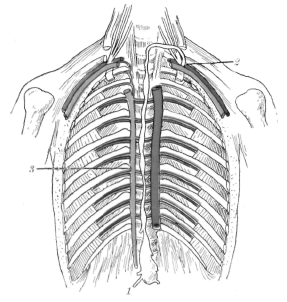
Fig. 21.—The Thoracic Duct. 1, Receptaculum chyli; 2, ending of duct ; 3, azygos major vein.
Lymphatics do not carry to the tissues : they are absorbents ; they absorb and carry away from the tissues all the material they do not need. All that the blood capillaries leave behind the lymphatic capillaries take up ; some of this is waste and some is matter which may be used again. The lymph thus absorbed is collected by the lymphatic vessels, passed through the lymphatic glands, and finally emptied into the ducts.
The lymphatics of the right arm, of the right side of the head and upper part of the trunk, take up the lymph from these parts and carry it to the right lymphatic duct, which is a short vessel about an inch long, emptying into the innominate vein.
The vessels from the rest of the body, including those of the intestines, carry the lymph they collect to the thoracic duct, which extends from the second lumbar vertebra to the root of the neck. It lies in front of the vertebral column, inclining towards the left till it reaches the seventh cervical vertebra, when it arches forwards and downwards to pour its contents into the left innominate vein. It is about the size of a pencil, and is dilated at its lower end to receive the lymphatics from, the lower limbs and most of the abdominal viscera ; this dilatation is called the receptaculum chyli.
The thoracic duct is provided with valves at short intervals, and there is a valve at the end to prevent the return of lymph or blood from the veins.
Lymphatic glands are small solid bodies, varying in size, through which the lymph passes on its way to the ducts ; the lymphatics entering the glands are called afferent, those leaving, them efferent.
There are numbers of glands in the neck, armpit and groin ; in the arm and leg they are found as far as the elbow and knee in the course of the large bloodvessels. There are some in the external part of the head. They are numerous in the thorax and abdomen, where they are called the bronchial and mesenteric glands ; they run along the aorta, inferior vena cava and iliac vessels. Lymphatic glands are well supplied with blood.
The lymphatics of the head and face pass through the glands of the neck, the cervical glands.
The lymphatics of the upper limbs and the greater part of the back and chest converge to the glands of the armpit, the axillary glands.
The lymphatics of the lower limbs and lower part of the trunk converge to the glands in the groin, the inguinal glands. There is a constant interchange going on between the blood and the lymph, by the process of osmosis. The lymph is in the first place derived from the blood ; it is the blood plasma which has exuded through the walls of the capillaries, and through these same walls certain constituents of the lymph pass into the blood. The tissues are surrounded by lymph ; it fills the spaces between the walls of the capillaries and the fibres of the tissues ; each tissue takes from the lymph what it requires and returns used-up matter to the blood. Pressure on the tissues causes, by compressing the vessels, an onward flow of lymph, the return of which is prevented by the numerous valves.
The small intestines are lined with mucous membrane, having numbers of small projections called villi. Each villus is supplied with a network of lymphatic capillaries, here called lacteals, as well as with blood capillaries ; these are surrounded by digested food, and absorption takes place rapidly both by the lacteals and bloodvessels ; they also lie in the mucous membrane between the villi. The large intestine contains fewer lymphatics, and they are not called lacteals.
Lacteals have the power of selecting fat from the products of digestion. It is the presence of fat that gives the milky appearance to the lymph in the lacteals during digestion hence the name ; at other times the fluid differs little from that of other lymphatics. This milky fluid is called chyle, and is collected by the lymphatic vessels. In passing through the lymphatic glands the number of oily particles diminishes, white corpuscles and fibrin are formed, and it becomes more like blood as it goes on to be mixed with it in the veins.
The manipulations in massage must markedly affect the lymph flow. All muscular exercise does. Dr. M. Foster, in his ' Text-book of Physiology,' says : ' The widespread presence of valves in the lymphatic vessels causes every pressure on the tissues in which they lie to assist in the propulsion forward of the lymph. Hence muscular movements increase the flow. If a cannula be inserted in one of the larger lymphatic trunks of the limb of a dog, the discharge of lymph from the cannula will be more distinctly increased by movements, even passive movements of the limbs, than by anything else.'
It cannot, then, be doubted that massage has considerable effect on the lymph flow ; contractions of the muscles are produced by kneading and percussion ; these contractions force lymph out of the lymph spaces and cause it to be carried on through the vessels.
Continue to:


My Books

