


The Evolution Of Pathology. Part 8
Description
This section is from the book "The Hygienic System: Orthopathy", by Herbert M. Shelton. Also available from Amazon: Hygienic System Orthopathy.
The Evolution Of Pathology. Part 8
The supposition that the organic locality of an affection makes a difference in its essential nature or character is the source of much confusion. So-called local pathologies represent different aspects and consequences of the same thing--various outcroppings of the same subterranean strata. Trace these points of prominence but a step backward, remove the technical rubbish, and we disclose the same foundation for all of them. The superficially differing pathological states are readily seen to have a common origin and starting point. The minor transformations, represented in local pathologies, are, in their infinite varieties, parts of one vast transformation and, throughout, display the same law and cause.
It is not by accident that the regressive transformations, which occur in the various organs of the body, and which constitute the downward pathological evolution of the living organism, have common traits; are the same in fact. The regressive metamorphosis which occurs in one organ is the same in kind, and the result, also, of the same general antecedents, as are all the degenerative changes in other organs. The same principles underlie the production of pathology everywhere in the body. The same general principles which are found to govern the evolutionary process in the one case must necessarily be found of equal force in connection with the evolutionary process in all other cases. The unity of all pathology must be recognized if order is to be brought out of the present chaos.
There are some three or four or eight or ten general lines of pathological development; all the "diseases" are modifications of these few types. All have the same cellular changes, the same atrophy or degeneration, the same functional deviations, the same ultimate beginnings and the same common causes.
Whether we look at physiological modifications or histologieal changes, they are found to be the same in one organ as in another and to grow out of the same general causes. Is it inflammation in in the liver in hepatitis, or in the pancreas in pancreatitis, or in the kidneys in nephritis ? It is the same process, the same neuro-circulatory modification or adjustment. Is it hypertrophy or hyperplasia in the tonsils, or in the heart, or in the liver, or in the kidneys'? The two processes are the same in each organ. Is it an abscess in the liver, or in the lungs, or in the fallopian tubes? It does not differ in either location. Is it cardiac sclerosis, or vascular sclerosis, or hepatic sclerosis, or sclerosis somewhere else in the body? Its location does not change its essential nature. Is it tissue destruction in the liver in hepatic sclerosis, or in the pancreas in diabetes, or in the kidneys in Bright's disease? The destruction is the same wherever it occurs, Is it atrophy, or degeneration in the optic nerve, or in the spinal cord, or in the liver, or in the kidneys, or in the heart or arteries, or in any other organ? It is everywhere the same. Great as is the variety of "disease," there is, after all, only a few types of "structure" among them all.
When the pathology in each organ is stripped of its non-essential complications it is seen to be identical in each organ or structure. The knowledge that there is not one gymnopathology for diabetes and another essentially different pathology for Bright's disease leads directly to the conclusion that the regressive transformations constituting the pathology in both organs goes back to the same general causes for their explanation.
The essential principles which may be discerned as governing the most ordinary pathological phenomena in so-called "local diseases," must, of necessity, be found to govern the evolution of the whole pathological ensemble, regarded as an aggregate of "diseases," however varied the phenomena presented. From the first minute beginnings of pathology, downward to its culmination in death, the varied processes of pathological evolution are laid down in orderly sequence and along lines of special kinds, the regressive changes in the tissues occuring in orderly fashion from imperceptible beginnings to the characteristic form of the full-fledged pathology. From the minutest beginnings evolves the very worst stages of pathology. There is an unbroken succession which exists in the whole realm of pathology, whereby the very simplest forms of pathology are connected with the most complicated stages. The whole realm of pathology may be said to possess one vast geneological tree which binds all members thereof in one great family.
The old Norse conception figured all existence under the figure of a tree--Iggdrasil, the Ash Tree of Existence--a great living, organic existence. Prof. Huxley employed a similar figure to represent life according to the hypothesis of transmutation of species. We may conveniently employ a similar figure to picture pathological evolution. We may arrange pathological developments as if they were a tree--the tree divides into a few main branches, these subdividing into a number of branchlets, and these into smaller groups of twigs. The ends of the twigs represent "local pathologies," the smaller branches pathologic groups, larger branches systemic deteriorations and so on until we arrive at the trunk or the stem, from which they all branch representing Toxemia, and, finally, the smaller rootlets represent bad habits, the larger roots, represent habit aggregations, while the taproot represents enervation.
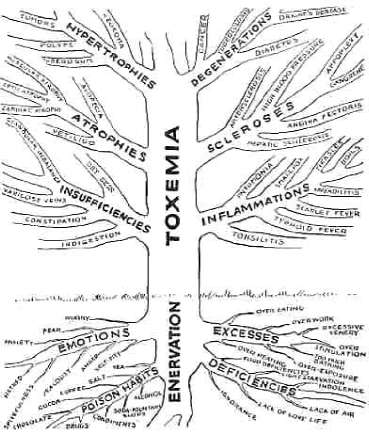
The accompanying diagramatic representation of the tree of pathology is not intended to give a complete picture of pathological evolution, but is merely suggestive of what the future tree will be like. Future pathologists will be able to lay down one continuous plan for the whole of the fully developed pathologies, and regard, Bright's disease, diabetes, sclerosis, etc., as being minor branches of one fundamental unity. Moreover, as inquiries into pathological evolution continue, all of the different forms of pathology met with in nature will lead us, not in one straight series, but by many roads, step by step, gradation by gradation, from cancer or Bright's disease at the lowest level of pathology, to minute changes at the beginning of the pathological series.
In the whole long list of medical fallacies, there is none more unscientific or absurd than an isolated pathology. So-called local pathologies are all parts of one general process and represent merely concomitant and successive developments from (he same cumulative causes.
Dr. Page expresses this as follows: "The fact is that there is a process of degeneration going on throughout the entire structure of the man, even to the last tissue, and the symptoms are all indicative of this, and this is more or less strictly true of all disorders. The naming and classifying of "disease" is calculated to mystify and mislead ; sickness is the proper term for describing them all; self-abuse, in the broadest sense of the word, is the cause of them; and obedience to law, the only means of prevention or cure."--The Natura1 Cure, p. 131.
Continue to:


My Books

