


Absorption, Assimilation, And The Processes Of Metabolism. Part 9
Description
This section is from the book "The Nutrition Of Man", by Russell H. Chittenden. Also available from Amazon: The Nutrition of Man.
Absorption, Assimilation, And The Processes Of Metabolism. Part 9
Turning now to another phase of tissue metabolism, we may consider briefly the nucleoproteids and their characteristic decomposition products; bodies which are widely distributed as cleavage products formed in the disintegration of most cell protoplasm, and having special interest in nutrition because of their chemical relationship to that well-known substance, uric acid. Nucleoproteids of some type are found in all cells; consequently they are present in all tissues, in all glandular organs, and their widespread distribution constitutes evidence of their great physiological importance. Nucleoproteids are compound substances made up of some form of proteid and nucleic acid. By simple hydrolysis with dilute mineral acids they are broken down into proteid, phosphoric acid, and one or more bodies known as nuclein bases. Of these latter substances, there are four well-defined bodies, viz., adenin, hypoxanthin, guanin, and xanthin, which from their peculiar chemical constitution are known as " purin bases." In the body, there is present in many cells a peculiar intracellular enzyme termed nucleate, which has the power of liberating these purin bases from their combination as a component part of tissue nucleoproteids, or of the contained nucleic acid. In autolysis or self-digestion of many glands, such as the spleen, thymus, etc., this chemical reaction is easily induced by action of the contained nuclease. Further, the liberated purin bases then undergo change because of the presence of certain deamidizing enzymes, and as a result guanin is transformed into xanthin, and adenin is converted into hypoxanthin. These ferments are true intracellular enzymes, and are termed respectively guanase and adenase. The real essence of the reaction they accomplish is clearly indiwzed by the following which show the

These two enzymes are typical hydrolying enzymes, but it is to be noted that there is not only a taking on of water with a retention of the oxygen, bat there is also a giving off of ammonia, by which the transformation is made possible. Adenin is known as an amino-porin and guanin as an amino-oxypurin, while hypoxanthin is an oxyporin and xanthin a dioxypurin. In other words, the two intracellular enzymes are able to transform the two amino-porins into the corresponding oxyporins; i.e., the enzymes are deamidizing ferments, liberating the NH, group of the adenin and guanin and thus forming two new compounds. These reactions, though more or less technical, are emphasized in this way not merely because they illustrate the action of intracellular enzymes in intermediary metabolism, thus affording a striking example of the gradual changes that take place in ordinary katabolic processes, but especially because they throw light upon the production of another substance common in body metabolism, viz., uric acid. It has long been known that nucleoproteids, nucleins, and other compounds containing these purin radicles, when taken as food, cause at once an increased output of uric acid, and it has been clearly recognized that in some way this latter substance, as a product of metabolism, must come from the transformation of nuclein bases. To-day, we understand that in many tissues, as in the liver, spleen, lungs, and muscle, there is present a peculiar oxidizing ferment, an oxidase, by the action of which hypo-xanthin can be converted into xanthin, and the latter directly oxidized to uric acid. This conversion into uric acid is purely a process of oxidation, brought about by a typical intracellular oxidase, known specifically as "xanthin oxidase," the reaction involved being as follows:
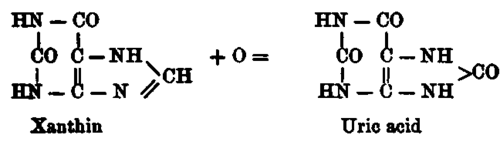
From these several reactions, it is clear how various intracellular enzymes working one after the other are able gradually to evolve uric acid from tissue nucleoproteids. Further, it is to be noted that there is another tissue oxidase contained principally in the kidneys, muscle, and liver which has the power of oxidizing and thus destroying uric acid, with formation, among other substances, of urea. Remembering that urea has the following chemical constitution it is easy to see, by comparison of the formulae, how uric acid might easily yield two molecules of urea through simple oxidation. In this way, excess of uric acid produced in the body can be converted into urea, and in this harmless form be excreted from the system.

Finally, reference should be made here to several other products of tissue metabolism, products of the breaking down of proteid matter in the body, since they are liable to prove of interest to us in other connections. Thus creatin, abundant in the muscle and other places; the related substance creatinin, present in the urine; methyl guanidin, a decomposition product of creatin; and urea, all call for a word of description. The chemical relationship of these bodies is clearly indicated by the following formulae:
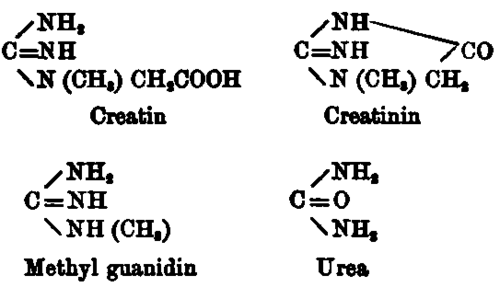
Creatinin is chemically the anhydride of creatin, i. e., it can be formed from creatin by the simple extraction of one molecule of water, H2O. Creatin, by hydrolytic cleavage, will break down into one molecule of urea and one molecule of sarcosin or methyl glycocoll, as shown in the following equation:

Continue to:


My Books

