


Iron Purlins
Description
This section is from the book "Notes On Building Construction", by Henry Fidler. Also available from Amazon: Notes on building construction.
Iron Purlins
These small purlins are generally of an L section - secured to the table of the Principal rafter by a cleat or bracket of angle iron (Fig. 386), or they are frequently filled in with wood, as shown in Fig. 387, for convenience in attaching the roof boarding or other covering.
Fig. 386.
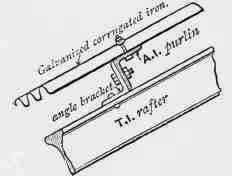
Fig. 388.
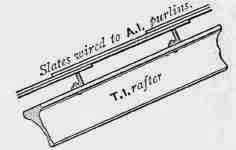

Fig. 387.
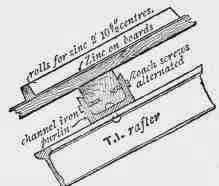
Fig. 389.
Angle laths are small angle irons placed at a distance apart, equal to the' gauge of the slates or the tiles they are to carry (Fig. 388). These are directly attached to them by wire.
Iron purlins of channel section (the latter filled in with wood) are also sometimes used (Fig. 389), or two angle irons riveted on to the back of the principal rafter and filled in with wood.
Wooden purlins are sometimes used. They may be notched on to the principal rafters, and secured to them either by an angle iron riveted to both, as in Fig. 363, or by being supported by a channel iron, as at P, Fig. 361.
The distance apart and arrangement of the purlins depend entirely upon the roof covering to be used.
Skylights And Lanterns
Illustrations of Skylights are given in Fig. 363, Fig. 392, Plate IV., Fig. 400, Plate V., Figs. 410, 413, Plate VI.; of Ventilates in Figs. 365, 366, and Fig. 429, Plate VIII.
Attachment To Columns And Girders
This is dealt with in Part II.
Coverings For Iron Roofs
Several kinds of covering are used for iron roofs - such as slates, corrugated iron, sheet iron, cast-iron plates, tiles (occasionally), zinc, and glass.
The peculiarities of these 'different materials will be discussed in Part II. The only roof covering which comes within the scope of the Elementary Course is slating (see p. 207).
Continue to:


My Books

