


Copings
Description
This section is from the book "A Treatise On Architecture And Building Construction Vol2: Masonry. Carpentry. Joinery", by The Colliery Engineer Co. Also available from Amazon: A Treatise On Architecture And Building Construction.
Copings
80. A wall having no roof covering should be capped by a wide stone called the coping. Terra cotta is occasionally used for this purpose, and sometimes tin. The upper surface of the coping should be pitched, as shown at a, Fig. 42, and should have a drip on the under side, as shown at b. The width of the coping should be about 3 or 4 inches more than that of the wall. Horizontal coping stones are often clamped together at the ends to prevent their becoming displaced.

Fig. 42.
81. Gable copings do not need to be pitched, but should project about 1 1/2 inches beyond the face of the outside wall, and should have a sharp outer edge to shed rain, so that it will not flow down the wall. The coping should be well anchored, either by bond stones or by long iron ties. A form of coping that is considerably used is shown in Fig. 43, in which a is the coping; c, the corbel; and b, the bottom stone, sometimes known as the kneeler, which should always be well bonded into the wall.

Fig. 43.
It is well to have long pieces of coping, so as to have as few joints as possible; a common length is 6 feet. A short piece, cut as shown at a, Fig. 44, should be inserted at intervals to securely bond the coping to the wall. In some cases the part resting on the wall is cut in steps, so that each stone has a level bearing, but this is objectionable, on account of the increased number of joints.
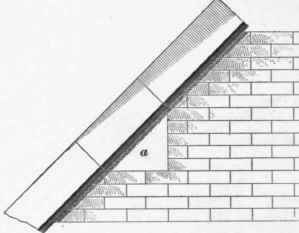
Fig. 44.
Continue to:


My Books

