


Small Letters Contrasted, Showing Probable Faults. Right And Wrong. Continued
Description
This section is from the book "Hill's Manual Of Social And Business Forms: A Guide To Correct Writing", by Thos. E. Hill. Also available from Amazon: Hill's Manual Of Social And Business Forms: The How-To-Do-Everything Book Of Victorian America.
Small Letters Contrasted, Showing Probable Faults. Right And Wrong. Continued

Wrong. Right.
1st M spreads too much at the top and has a bad capital stem. 2nd M is too close at the top, has a bad capital stem, the last O part spreading too much.

Wrong. Right.
1st V contains angles. 2nd V spreads too much at the top.

Wrong. Right.
1st E contains angles. 2nd E, out of proportion by being too large at the top.

Wrong. Right.
1st N has a bad capital stem, being too long and angular. 2nd N is out of proportion by spreading too much at the top.

Wrong. Right.
1st W contains angles in the upper portion of the first of the letter. 2nd W is out of proportion by having too much slope.

Wrong. Right.
1st F has the top too far to the left. 2nd F contains both a bad top and capital stem.

Wrong. Right.
1st O is too slim. 2nd O contains an angle at both top and bottom.

Wrong. Right.
1st X contains several angles where there should be none. 2nd X is spread too much.

Wrong. Right.
1st G is too small at the top. 2nd G is too large at the top

Wrong. Right.
1st P is too small at the top. 2nd phas the top too large.
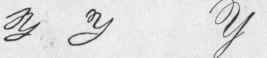
Wrong. Right.
1st V has the top too long. 2nd Y is too small at the top.

Wrong. Right.
1st H has a bad capital stem. 2nd H resembles an X.

Wrong. Right.
1st Q contains angles. 2nd Q is too large at the top.

Wrong. Right.
1st Z resembles a small letter y. 2nd Z is also illegible.

Wrong. Right.
1st / is too broad, and has the loop too large. 2nd I has a bad capital stem.

Wrong. Right.
1st R is too large at the top. 2nd R contains angles.

Wrong. Right.
1st character & is too slim. 2nd character spreads too much. Both slope badly.
Description Of The Plates
EVERY Copy on Plates Nos. 1, 2, 3 and 4 should be written with care by all students desirous of improving their penmanship. Ladies can, if they wish, terminate with the finer hand, while gentlemen will end with the bolder penmanship.
Plate I.
Copy 1 is a free, off-hand exercise, calculated to give freedom and ease in writing. Observe to make an angle, top and bottom. A sufficient amount of practice on this copy, with pen or pencil, will break up all stiffness in the writing.
Copy 2 is the contraction of copy No. 1 into the letter giving a free, open, bold, business hand.

Copy 3 is composed of words of greater length, which should be written, if possible, by the student, from the beginning to the end of the word, without removing the pen from the paper until the word is finished. The words are composed principally of the letter which should be written with much care.

Copies 4 and 5 are the small letters of the alphabet. Carefully observe the shades, and the uniformity in slope of letters.
Copy 6 exhibits the figures, which are twice the height of small letters. The 7 and 9, in script, extend one-half their length below the line.
Copies 7 and 8 are the capital letters of the alphabet, which are of the same height as the small letter

There is usually but one shade in a letter. Observe the directions, given elsewhere, for the making of capitals, and guard against the probable faults, as there expressed. Study also, carefully, the principles of curves, proportion and shades, as applied in the making of capital letters.
The remainder of copies on Plates 1 and 2 should be written with the greatest care, "Perseverance" being the motto. Do not leave these copies until they are thoroughly mastered.
Plate III.
This plate is composed of copies similar to the others, the same principles being applicable in the making of the letters. As will be seen, this is a much more delicate hand, and is especially adapted to fine epistolary writing.
Plate IV.
Plate IV illustrates the form of writing a letter of introduction, and may be copied by the student as a specimen business letter.
Plate V.
This plate exhibits the off-hand capitals, which should be made purely with the arm movement, the hand resting lightly on the two lower fingers. Practice, at first, in making them with a lead-pencil on waste paper, will be found quite beneficial.
Plate VI.
The copies of Round Hand on this plate should be written with especial care, being the style suitable for headings, etc. Observe in the small letters that each is round, and every down mark shaded. The alphabet of German Text on this page will be found useful for ornamental work.
Plate VII.
Plate VII exhibits a variety of pen work, containing both fine and bold penmanship, and will be found a superior copy in which the student can display a knowledge of penmanship and flourishing.
Plate VIII.
Plate VIII is an original off-hand specimen of flourishing, the curves, proportion and shades in which should be carefully observed. (See view of holding pen in flourishing, page 27.)
PLATE I

PLATE II

Blackboard Flourishing
The plates, representing flourishing in white lines on dark groundwork, though designed to represent off-hand work upon the blackboard, will be found equally useful for practice with the pen. The figure of the Swan from Packard and Williams' "Gems of Penmanship" is a beautiful piece of flourishing, which finely illustrates how true to nature an object may be made with but very few strokes of the pen. As will be seen, the figures on these plates are composed wholly of curved lines.
Continue to:


My Books

