


Leclanche Battery
Description
This section is from the book "American Library Edition Of Workshop Receipts", by Ernest Spon. Also available from Amazon: American Library Edition Of Workshop Receipts.
Leclanche Battery
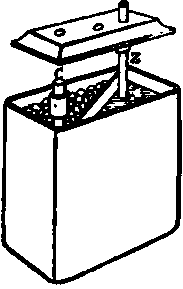
This form of battery, Fig. 38, is in very general use for electric bells, its great recommendation being that, once charged, it retains its power without attention for several years. 2 jars are employed in its construction : the outer one is of glass, contains a zinc rod, and is charged with a solution of ammonium chloride (sal ammoniac). The inner jar is of porous earthenware, contains a carbon plate, and is filled up with a mixture of manganese peroxide and broken gas carbon. When the carbon plate and the zinc rod are connected, a steady current of electricity is set up, the chemical reaction which takes place being as follows:-The zinc becomes oxidized by the oxygen from the manganese peroxide, and is subsequently converted into zinc chloride by the action of the sal-ammoniac. After the battery has been in continuous use for some hours, the manganese becomes exhausted of oxygen, and the force of the electrical current is greatly diminished; but if the battery be allowed to rest for a short time, the manganese obtains a fresh supply of oxygen from the atmosphere, and is again fit for use.
After about 18 months' work, the glass cell will probably require recharging with sal-ammoniac, and the zinc rod may also need renewing; but should the porous cell get out of order, it is better to get a new one entirely, than to attempt to recharge it. (Dyer.)
Fig. 37.
Continue to:


My Books

