


![next page: 14. Adiantum [Tourn.] L. Sp. Pl 1094. 1753](../../../images/nav/page_next.gif)
13. Athyrium Roth, Romer's Arch. Bot. 21: 105. 1799
Description
This section is from the book "An Illustrated Flora Of The Northern United States, Canada And The British Possessions Vol1", by Nathaniel Lord Britton, Addison Brown. Also available from Amazon: An Illustrated Flora of the Northern United States, Canada and the British Possessions. 3 Volume Set..
13. Athyrium Roth, Romer's Arch. Bot. 21: 105. 1799
Medium-sized or large ferns with greenish succulent stipes and 1-3-pinnate or pinnatihd blades; veins free; scales of the rootstock delicate, of thin-walled cells. .Sori usually curved, oblong to linear-oblong, or crossing the vein and recurved, sometimes unequally hippocrepi-form, rarely roundish. Indusia shaped like the sorus, attached as in Asplenium, subentire to fimbriate, rarely vestigial and concealed. [Greek, shieldless, of doubtful application.]
A genus of about 85 species, mainly of tropical regions. A. cyclosontm occurs in western North America. Type species: Athyrinm Filix-foemina (L.) Roth.
1. Athyrium Thelypteroides (Michx.) Desv. Silvery Spleenwort
Fig. 69
Asplenium acrostichoides Sw. Schrad. Journ. Bot. 18002: 54. 1801. Not Athyrium acrostichoideum Bory, 1836.
Asplenium thelypteroides Michx. Fl. Bor. Am. 2: 265. 1803.
Athyrium thelypteroides Desv. Mem. Soc. Linn. Paris 6: 266. 1827.
Rootstock slender, sinuous, creeping. Stipes 8'-16' long, straw-colored, somewhat chaffy below, at least when young; blades lanceolate, oblong-lanceolate, or ovate-oblong, 1°-3° long, 6'-12' wide, acute or acuminate, narrowed to the base, very deeply bipinnatifid; pinnae linear-lanceolate to oblong-lanceolate, sessile, acuminate, deeply pinnatifid into numerous oblong obtuse or subacute lightly serrate-crenate segments; sori crowded, curved or straight, the lower often double; indusium light-colored and shining when young.
In rich moist woods, Nova Scotia to Minnesota, Missouri and Georgia. Ascends to 5000 ft. in Virginia. Closely related forms occur in eastern Asia. Aug.-Oct.
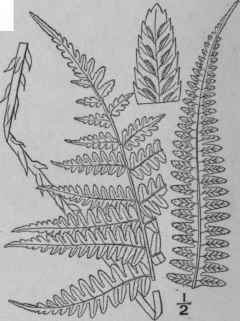

2. Athyrium Filix-Foemina (L.) Roth. Lady-Fern. Female-Fern
Fig. 70
Polypodium Filix-foemina L. Sp. PI. 1090. 1753. Asplenium Filix-foemina Bernh. Schrad. Neues Journ.
Bot. 12: 26. 1806. A. Filix-foemina Roth, Romer's Arch. 21: 106. 1799.
Rootstock creeping or ascending, slender for,the size of the plant. Stipes tufted, 6-12' long, straw-colored, brownish or reddish; blades broadly oblong-ovate to oblong-lanceolate, acuminate, l°-3° long, 2-pinnate; pinnae lanceolate, acuminate, short-stalked or the upper ones sessile, 4'-8' long; pinnules oblong-lanceolate to broadly elliptical, incised or serrate, the lobes or teeth often again toothed, those toward the ends of the pinnae confluent; sori short; indusia straight or curved, sometimes horseshoe-shaped.
In woods and thickets, Newfoundland to British Columbia, the Gulf states, and California. Ascends to 6000 ft. in North Carolina, and to 2000 ft. in Vermont. Europe and Asia. June-Aug. Backache-brake.
Blades bipinnatifid; segments lightly crenate-serrate. | 1. | A. thelypteroidcs. |
Blades bipinnate; pinnules variously incised or deeply serrate. | 2. | A. Filix-foemina. |
Continue to:


My Books

