


13. Pogonia Juss. Gen. Pi. 65. 1789
Description
This section is from the book "An Illustrated Flora Of The Northern United States, Canada And The British Possessions Vol1", by Nathaniel Lord Britton, Addison Brown. Also available from Amazon: An Illustrated Flora of the Northern United States, Canada and the British Possessions. 3 Volume Set..
13. Pogonia Juss. Gen. Pi. 65. 1789
Mostly low herbs, the flowers terminal, solitary, the leaves alternate. Sepals and petals separate, erect or ascending. Lip erect from the base of the column, spurless. Column elongated, club-shaped at the summit. Anther terminal, stalked, attached to the back of the column, its sacs parallel; pollinia 2, 1 in each sac, powdery-granular, without a caudicle. Stigma a flattened disk below the anther. Capsule oblong or ovoid, erect. [Greek, bearded, from the bearded lip of the type species.]
A few species of the north temperate zone; only the following known in North America. Type species: Arethusa ophioglossoides L.
Sepals and petals nearly equal and alike: lip bearded. | 1. | P. ophioglossoides. |
Sepals longer and narrower than the petals; lip not bearded. | 2. | P. divaricata. |
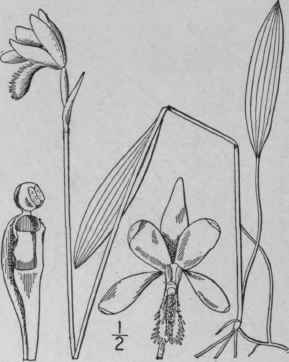
1. Pogonia Ophioglossoides (L.) Ker. Rose Pogonia. Snake-Mouth
Fig. 1381
Arethusa ophioglossoides L. Sp. PI. 951. 1753.
Pogonia ophioglossoides Ker, in Lindl. Bot. Reg. pi. 148. 1816.
Stem 8'-15' high, 1-3-leaved, not rarely with a long-petioled basal leaf. Stem leaf or leaves 1/2'-3' long, lanceolate or ovate, erect, bluntly acute; flowers fragrant, pale rose-color, slightly nodding, large, solitary or occasionally in pairs, subtended by a foliaceous bract; sepals and petals about equal, elliptic or oval, 6"-10" long; lip spatulate, free or somewhat appressed to the column below, crested and fringed; column much shorter than the petals, thick, club-shaped.
In meadows and swamps, Newfoundland to Ontario, Minnesota, Florida, Kansas and Texas. Also in Japan. Roots fibrous. Propagates by runners. Adder's-mouth pogonia. June-July.
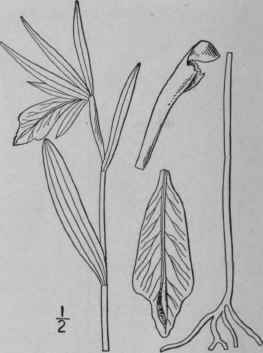
2. Pogonia Divaricata (L.) R. Br. Spreading Pogonia
Fig. 1382
Arethusa divaricata L. Sp. PI. 951. 1753.
Pogonia divaricata R. Br. in Ait. Hort. Kew. Ed. 2, 5: 203. 1813.
Stem i°-2° high, bearing a leaf near the middle, and a foliaceous bract near the flower. Leaf lanceolate, or narrowly elliptic, obtuse, clasping, 2'-4' long; flower terminal, solitary, about 1' long; sepals linear, longer and narrower than the petals, diverging, dark colored; petals flesh-color, lanceolate, narrowed at the apex, lip as long as the petals, 3-lobed, crenulate or wavy-margined, greenish, veined with purple, crested, but not bearded, the upper lobe long.
In swamps, southern New Jersey to Florida and Alabama. Ascends to 4000 ft. in North Carolina. July.
Continue to:


My Books

