


17. Panicum L. Sp. Pi. 55. 1753. Part 2
Description
This section is from the book "An Illustrated Flora Of The Northern United States, Canada And The British Possessions Vol1", by Nathaniel Lord Britton, Addison Brown. Also available from Amazon: An Illustrated Flora of the Northern United States, Canada and the British Possessions. 3 Volume Set..
17. Panicum L. Sp. Pi. 55. 1753. Part 2
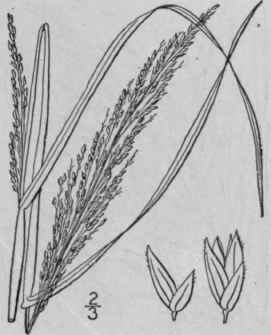
1. Panicum Hemitomon Schult. Maiden-Cane. Simpson's-Grass
Fig. 311
Panicum hemitomon Schult. Mant. 2: 227. 1824. Panicum carinatum Torr. Bost. Journ. Nat. Hist. 1:
137- 1835. Not Presl, 1830. Panicum digitarioides Carpenter; Steud. Syn. PI. Gram.
75- 1855-Panicum Curtisii Chapm. Fl. S. States, 573. i860.
Not Steud. 1855. Brachiaria digiiarioides Nash, in Britt. Man. 77. 1901.
Glabrous, culms erect from a long and stout creeping rootstock, 3°-5° tall, simple, stout, smooth. Sheaths smooth; blades 4'-10' long, 4"-8" wide, long-acuminate; panicle linear, 6'-12' long, its branches 1'-3' long, erect; spikelets about 1 1/4" long, ovate, acute; first scale about one-half as long as the spikelet, acute, 3-nerved; second about 1" long, 5-nerved and a little exceeded by the 3-nerved third one; the fourth slightly shorter than the third.
In water, New Jersey to Florida and Texas. July-Aug.

2. Panicum Obtusum H.B.K. Blunt Panic-Grass. Wire-Or Range-Grass
Fig. 312
Panicum obtusum H.B.K. Nov. Gen. 1: 98. 1816. Brachiaria obtusa Nash, in Britt. Man. 77. 1901.
Glabrous, culms erect, 1°-2° tall, simple or branching at base, smooth. Sheaths smooth; blades 2 1/2-9' long, 1"-3" wide, usually erect, long-acuminate; panicle linear, 2'-6' long; branches 3/4'- 1 1/2' long, ap-pressed; spikelets about 1 1/2" long, crowded, oval or obovoid, obtuse, turgid; first scale shorter than the rest, obtuse, 5-nerved; second, third and fourth scales about equal, the second and third 5-nerved.
Usually in dry soil, Missouri to Arizona and Mexico. Vine Mesquite-, or Grape-vme-grass. July-Sept.
3. Panicum Verrucosum Muhl. Warty Panic-Grass
Fig. 313
Panicum verrucosum Muhl. Gram. 113. 1817. Panicum debile Ell. Bot. S. C. & Ga. 1: 129. 1817. Not Desf. 1800.
Culms erect or decumbent, slender, generally much branched at base, 1°-6° long. Sheaths glabrous, much shorter than the internodes; ligule short, ciliate; blades 2'-7' Jong, 1"-4" wide, erect or ascending, glabrous, rough on the margins; panicle 3'-12' long, its lower branches 2r-6' long, naked below, strict and ascending, or lax and spreading, and smaller panicles sometimes produced at the lower part of the culm; spikelets about 3/4" long, elliptic, acutish; the first scale about one-quarter as long as the warty second and third, the fourth scale apiculate.
Moist soil, Massachusetts to Missouri, south to Florida and Texas, mostly near the coast. July-Sept.

4. Panicum Dichotomiflorum Michx. Spreading Witch-Grass
Fig. 314
Panicum dichotomiflorum Michx. Fl. Bor. Am. 1: 48.
1803. Panicum geniculatum Muhl. Gram. 123. 1817.
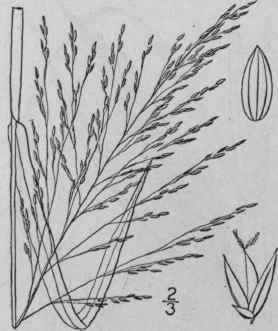
Culms at first erect, 1°-2° tall, simple, later decumbent and geniculate, 4°-6° long, branched at all the upper nodes. Sheaths loose, glabrous, somewhat flattened; ligule ciliate; blades 6'-2° long, 2"'-10" wide, long-acuminate, scabrous on the margins and occasionally on the nerves; panicle pyramidal, 4'-16' long, lower branches 3-6' long, at length widely spreading; spikelets 1"-1 1/2" long, crowded, lanceolate, acute, glabrous, sometimes purplish; first scale about one-fourth as long as the spikelet, enclosing its base; second and third scales about equal, acute, 5-7-nerved; fourth scale elliptic, shining, shorter than or equalling the third.
In wet soil, Maine to Nebraska, Florida. Texas and California. Also in the West Indies and continental tropical America. Formerly confused with P. prolif-erum Lam. Sprouting Crab-grass. July-Sept.
Continue to:


My Books

