
![previous page: 2. Salix [Tourn.] L. Sp. Pi. 1015. 1753. Part 7](../../../images/nav/page_prev.gif)

![next page: 2. Salix [Tourn.] L. Sp. Pi. 1015. 1753. Part 9](../../../images/nav/page_next.gif)
2. Salix [Tourn.] L. Sp. Pi. 1015. 1753. Part 8
Description
This section is from the book "An Illustrated Flora Of The Northern United States, Canada And The British Possessions Vol1", by Nathaniel Lord Britton, Addison Brown. Also available from Amazon: An Illustrated Flora of the Northern United States, Canada and the British Possessions. 3 Volume Set..
2. Salix [Tourn.] L. Sp. Pi. 1015. 1753. Part 8
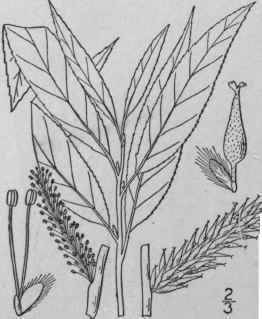
19. Salix Sericea Marsh. Silky Willow
Fig. 1469
Salix sericea Marsh. Arb. Am. 140. 1785. Salix coactilis Fernald, Rhodora 8: 22. 1906.
A shrub, 5°-12° tall, with slender purplish puberulent twigs, the young leaves densely silky-pubescent. Mature leaves glabrous or pubescent, lanceolate, acuminate, narrowed or obtuse at the base, serrulate all around with gland-tipped teeth, dark green above, paler and somewhat glaucous beneath, turning brown or black in drying, 2V-4' long, 5"-10" wide; stipules narrow, deciduous; petioles 2"-7" long, sometimes glandular; aments expanding before the leaves, sessile, the pistillate with a few leaves at the base, dense, the staminate about 1' long, the pistillate l'-l 1/2 long in fruit; bracts villous, persistent; stamens 2; filaments glabrous; style short; capsule ovoid-oblong, obtuse, pubescent, short-pedicelled, about 1 1/2"' long.
In swamps and along streams, New Brunswick to Michigan, North Carolina and Ohio. May.
Salix subsericea (Anders.) Schneider, of eastern Massachusetts, has leaf and capsule characters intermediate between this species and the following one, and has been regarded both as a hybrid and as a distinct species.
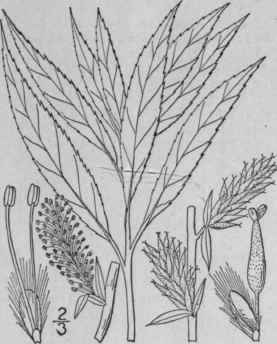
20. Salix Petiolaris J. E. Smith. Slender Willow
Fig. 1470
S. petiolaris J. E. Smith, Trans. Linn. Soc. 6: 122. 1802. S. gracilis Anders. Proc. Am. Acad. 4: 67. 1858.
A shrub, similar to the preceding species, but the young leaves only slightly silky, the branches slender, upright or ascending. Mature leaves lanceolate, acuminate at both ends, serrulate with blunt cartilaginous teeth, remaining green in drying, 4"-8" wide; petioles 2"-5" long; stipules deciduous; aments expanding before the leaves, the pistillate short-peduncled, usually rather loose, about 1' long in fruit; bracts villous, oblong to obovate; stamens 2; filaments glabrous; stigmas nearly sessile; capsule tapering from an ovoid or oblong base, pubescent, 2 1/2"-4 long, usually about twice as long as the filiform pedicel.
Swamps, New Brunswick to Manitoba, Tennessee, Michigan and North Dakota. Dark long-leaved willow. May.
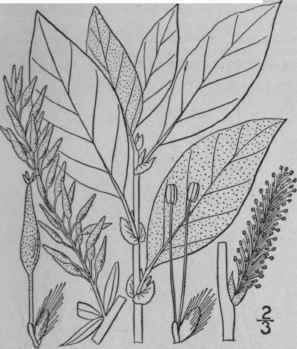
21. Salix Bebbiana Sarg. Beaked, Livid Or Bebb's Willow
Fig. 1471
Salix rostrata Richards. Frank. Journ. App. 753.
1823. Not Thuill. 1799. Salix Bebbiana Sarg. Gard. & For. 8: 463. 1895.
A shrub, 6°-18° tall, or sometimes a tree 25° high, the twigs pubescent or puberulent, terete. Leaves elliptic, oblong or oblong-lanceolate, acute, acuminate or some of them blunt at the apex, rounded or narrowed at the base, sparingly serrate or entire, dull green and puberulent above, pale, reticulate-veined and tomen-tose beneath or nearly glabrous on both sides when very old; petioles 2"-6" long; stipules semicordate, acute, deciduous; aments sessile, expanding with or before the leaves, dense, the staminate l'-1 1/2' long, the pistillate 2' long in fruit; bracts villous; stamens 2; filaments distinct, glabrous; stigmas nearly sessile; capsule very narrowly long-conic, densely pubescent, twice as long as the filiform pedicel. Dry soil and along streams, Newfoundland to Alaska, New Jersey, Nebraska and Utah. April-May. Salix perrostrata Rydb., inhabiting hillsides and stream-banks from Nebraska and South Dakota to New Mexico and Yukon Territory, differs in having leaves thinner, glabrous when mature.
Continue to:


My Books

