


3. Calla L. Sp. Pl 968. 1753
Description
This section is from the book "An Illustrated Flora Of The Northern United States, Canada And The British Possessions Vol1", by Nathaniel Lord Britton, Addison Brown. Also available from Amazon: An Illustrated Flora of the Northern United States, Canada and the British Possessions. 3 Volume Set..
3. Calla L. Sp. Pl 968. 1753
A bog herb with slender acrid rootstocks, broadly ovate or nearly orbicular cordate leaves, and a large white persistent spathe. Spathe ovate-lanceolate or elliptic, acuminate, open. Spadix cylindric, much shorter than the spathe, densely covered with flowers. Flowers perfect or the very uppermost staminate; perianth none. Stamens about 6; filaments linear, longer than the anthers; anther-sacs divaricate, opening by slits. Ovary ovoid, i-celled; style very short; stigma small, flat, circular. Ovules 6-9, anatropous. Berries obconic, depressed. Seeds hard, smooth, oblong, striate toward the micropyle and pitted at the other end. Endosperm copious. [An ancient name, taken from Pliny.]
A monotypic genus of the cooler portions of the north temperate zone.
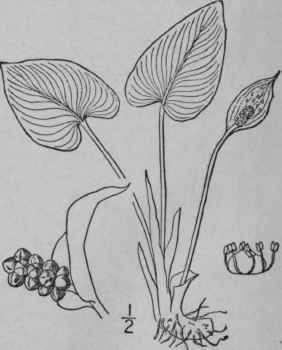
1. Calla Palustris L. Water Arum. Wild Calla
Fig. 1116
Calla palustris L. Sp. PI. 968. 1753.
Petioles 4'-8' long, spreading or ascending. Blades thick, entire, 1 1/2'-4' wide, cuspidate or abruptly acute at the apex, deeply cordate at the base; scapes as long as the petioles, sheathed at the base; rootstocks covered with sheathing scales and with fibrous roots at the nodes; spathe 1'-2 1/2' long and about 1' wide, with an abruptly acuminate involute apex; spadix about 1' long; berries red, distinct, few-seeded, forming a large head when mature.
In bogs, Nova Scotia to Hudson Bay, Minnesota, New Jersey, Pennsylvania, Wisconsin and Iowa. Reported from Virginia. Also in Europe and Asia. Female or water-dragon. Water-lily. Swamp-robin. May-June. Fruit ripe July-Aug.
Continue to:


My Books

