


3. Rumex L. Sp. Pi. 333. 1753. Part 3
Description
This section is from the book "An Illustrated Flora Of The Northern United States, Canada And The British Possessions Vol1", by Nathaniel Lord Britton, Addison Brown. Also available from Amazon: An Illustrated Flora of the Northern United States, Canada and the British Possessions. 3 Volume Set..
3. Rumex L. Sp. Pi. 333. 1753. Part 3
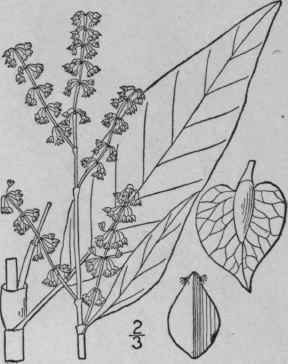
4. Rumex Venosus Pursh. Veined Or Winged Dock
Fig. 1600
Rumex venosus Pursh, Fl. Am. Sept. 733. 1814.
Perennial by a woody rootstock, glabrous; stem rather stout, erect, somewhat flexuous, 6'-15' tall, grooved, branched. Leaves ovate, ovate-lanceolate or oblong, 1'-5' long, acute at both ends or acuminate at the base, petioled, rather coriaceous; ocreae funnelform, thin, brittle; racemes mostly erect, soon interrupted; calyx red, pedicelled, very conspicuously winged in fruit; pedicels at maturity rather stout, slightly shorter than the wings, jointed at about the middle; wings large, 1/2'-1 1/2' broad, suborbicular with a deep sinus at the base, veiny, reddish; style-branches divergent in fruit; achene 3" long, smooth, shining, its faces concave, its angles margined.
Saskatchewan to Oregon and Washington, south to Missouri and Nevada. May-Aug.
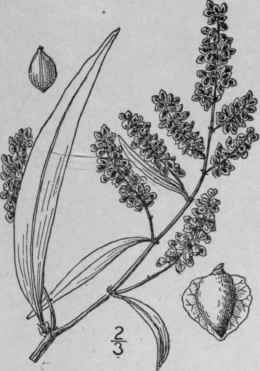
5. Rumex Pallidus Bigel. Large-Tubercled Dock
Fig. 1601
Rumex pallidus Bigel. Fl. Bost. Ed. 3, 153. 1840.
Perennial, glabrous, somewhat glaucous; stem depressed or ascending, often zigzag, 1°-2 1/2° long. Leaves oblong to narrowly lanceolate or almost linear, acute or acuminate at both ends, petioled, rather fleshy; racemes, at least the lower ones, spreading or reflexed, very dense; calyx pale; pedicels shorter than' the wings, jointed below the middle; wings deltoid or ovate-deltoid, 1 1/2"-2" long, undulate, each bearing a large broadly ovoid tubercle; achene 1"-1 1/2" long, red, its angles narrowly margined.
On beaches, rocks and in salt marshes along the coast, Nova Scotia, New Brunswick and New England. June-Sept.
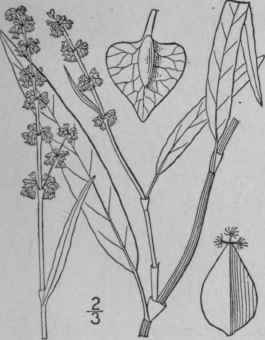
6. Rumex Mexicanus Meisn. White, Pale Or Willow-Leaved Dock
Fig. 1602
R. salicifolius Hook. Fl. Bor. Am. 2: 129. 1840. Not Weinm. 1821. R. mexicanus Meisn. in DC. Prodr. 14: 45. 1856.
Perennial, glabrous, pale green; stem erect or ascending, simple or branched, grooved, flexuous, 1°-3° high. Leaves lanceolate, linear-lanceolate or the lower oblong, acute or acuminate at both ends, or rarely obtuse at the apex, petioled; racemes erect or ascending, dense, in fruit interrupted below; flowers in dense clusters; calyx pale green, 1" long, pedicelled, winged in fruit; pedicels slightly longer than the wings, jointed near the base; wings triangular-ovate, 1 1/2" long, undulate or subdentate, each bearing a narrowly ovoid or oblong tubercle; achene 1" long, dark red, smooth, shining, its faces concave, its angles slightly margined.
In moist, rich or rocky soil, Labrador and Newfoundland to Maine, British Columbia, Texas and Mexico. Occasionally introduced eastward. May-Sept.
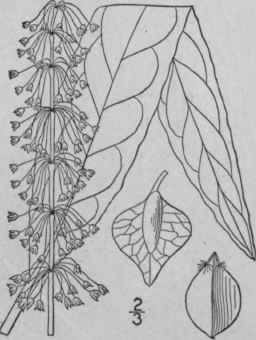
7. Rumex Verticillatus L. Swamp Dock
Fig. 1603
Rumex verticillatus L. Sp. PI. 334. 1753.
Perennial, glabrous, rather bright green; stem stout, grooved, simple or nearly so, erect, ascending or decumbent, 2°-5° long, more or less flexuous when old. Leaves narrowly oblong, oblong-lanceolate or lanceolate, 2-12' long, narrowed at both ends or obtusish at the apex, slightly papillose, long-petioled; racemes interrupted below, spreading in fruit; flowers in rather dense whorls; calyx green, 1" long, winged in fruit; pedicels stout, thickened above, jointed near the base, 1-5 times as long as the wings; wings broadly deltoid, 2" long, more or less decurrent on the pedicel, each bearing a narrowly ovoid tubercle; achene 1 1/4" long, reddish, pointed, smooth, shining, its faces concave.
In swamps, Quebec and Ontario to Iowa, south to Florida and Texas. May-July.
Continue to:


My Books

