


92. Poa L. Sp. Pi. 67. 1753. Part 4
Description
This section is from the book "An Illustrated Flora Of The Northern United States, Canada And The British Possessions Vol1", by Nathaniel Lord Britton, Addison Brown. Also available from Amazon: An Illustrated Flora of the Northern United States, Canada and the British Possessions. 3 Volume Set..
92. Poa L. Sp. Pi. 67. 1753. Part 4
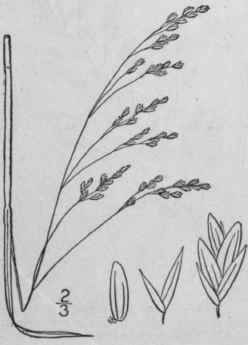
9. Poa Debilis Torr. Weak Spear-Grass
Fig. 612
Poa debilis Torr. Fl. N. Y. 2: 459. 1843.
Culms 1°-2 1/2° tall, erect, slender, simple, somewhat flattened, smooth and glabrous. Sheaths compressed, much shorter than the internodes; ligule 1/2"-1" long; blades 1'- 4 1/2' long, 1" wide or less, erect, smooth beneath, rough above; panicle 2'-6' in length, open, often nodding at the top, the branches erect or ascending, sometimes spreading, 1 1/2'-3' long; spikelets 2-4-flow-ered,1 1/2"-2" long, their pedicels longer; empty scales unequal, acute, the first 1-nerved, shorter than the 3-nerved second one; flowering scales 1 1/2" long, obtuse, sparingly webbed at the base, 5-nerved, the nerves naked.
In woods, Quebec and Ontario to Rhode Island, Pennsylvania, Illinois and Iowa. June-Aug.
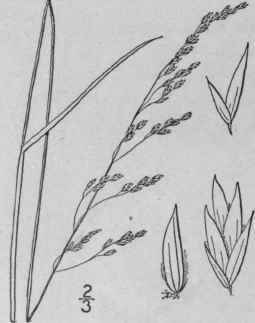
10. Poa Crocata Michx. Wood Meadow-Grass. Northern Spear-Grass
Fig. 613
Poa caesia var. strictior A. Gray, Man. Ed. 5, 629. 1867. P. crocata Michx. Fl. Bor. Am. 1: 68. 1803.
Culms 6'-2° tall, erect, simple, slender, sometimes rigid, smooth and glabrous. Sheaths usually shorter than the internodes; ligule 1/2"-1" long, truncate; blades 1-4' long, 1" wide or less, erect, smooth or rough; panicle 2'-5' in length, open, the branches erect or ascending, rarely spreading, 1'-2' long; spikelets 2-5-flowered, 1 1/2"-2 1/2" long; lower scales acute or acuminate, 1-3-nerved; flowering scales obtuse or acute, 1"- 1 1/4" long, faintly 5-nerved, somewhat webby at base, the midnerve and the marginal nerves silky-pubescent on the lower half.
Labrador to Yukon, Vermont, Minnesota and Alberta, and in the mountains to Colorado and Arizona. June-Aug.
Poa nemoralis L., a grass of Europe and Asia, may be found as an occasional introduction. It may be distinguished from the above by its much narrower empty scales.
11. Poa Triflora Gilib. False Red-Top. Fowl Meadow-Grass
Fig. 614
Poa serotina Ehrh. Beitr. 6: 83. Name only. 1791. P. triflora Gilib. Exercit. 531. 1792.
Culms 1 1/2°-5° tall, erect, simple or rarely branched, smooth, glabrous. Sheaths usually shorter than the internodes, smooth and glabrous; ligule 1 "-2" long; blades 2'-6' long, 1"-2" wide, smooth or rough; panicle 6'-13' in length, open, the branches spreading or ascending, 2'-5' long, divided and spikelet-bearing above the middle; spikelets 3-5-flowered, 1 1/2"-2" long, exceeding their pedicels; lower scales acute, glabrous, rough above on the keel, the lower usually 1-nerved, the upper 3-nerved; flowering scales obtuse, somewhat webby at the base, 1"-1 1/2" long, silky-pubescent on the lower half of the marginal nerves and the midnerve, the intermediate nerves obscure or wanting.
In swampy places, Newfoundland to Vancouver Island, south to New Jersey and Colorado. Also in Europe and Asia. Duck-grass. July-Aug. Formerly confused with Poa flava L.


Continue to:


My Books

