


96. Panicularia Fabr. Enum. Hort. Helmst. 373. 1763. Part 2
Description
This section is from the book "An Illustrated Flora Of The Northern United States, Canada And The British Possessions Vol1", by Nathaniel Lord Britton, Addison Brown. Also available from Amazon: An Illustrated Flora of the Northern United States, Canada and the British Possessions. 3 Volume Set..
96. Panicularia Fabr. Enum. Hort. Helmst. 373. 1763. Part 2
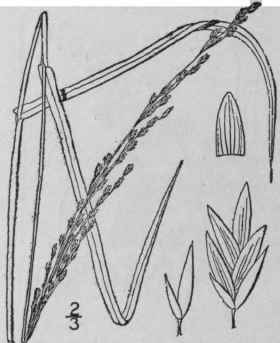
1. Panicularia Laxa Scribn. Northern Manna-Grass
Fig. 632
Panicularia laxa Scribn. Bull. Torr. Club 21: 37. 1894.
Glyceria laxa Scribn.; Redf. & Rand, Fl. Mt. Desert, 180. 1894.
Culms 2°-4° tall, erect, simple, smooth or slightly scabrous. Sheaths overlapping, rough; ligule 1/2"-1" long; blades 8'-15' long, 2"-4" wide, very rough; panicle 7'-9' in length, the branches spreading or ascending, the lower 3'-6' long; spikelets 3-5-flowered, about 2" long; empty scales unequal, scarious, acute, 1-nerved, the first one-half to two-thirds the length of the second; flowering scales broad, about 1" long, twice the length of the second scale, obtuse, obscurely 7-nerved.
In water or wet soil. Nova Scotia to Maine, New Jersey and Pennsylvania. Aug.

2. Panicularia Canadensis (Michx.) Kuntze. Rattlesnake-Grass
Fig. 633
Briza canadensis Michx. Fl. Bor. Am. 1:71. 1803. Glyceria canadensis Trin. Mem. Acad. St. Petersb. (VI.)
1: 366. 1831. Panicularia canadensis Kuntze, Rev. Gen. PI. 783. 1891.
Culms 2°-3° tall, erect, simple, smooth or slightly scabrous. Sheaths shorter than the internodes, those at the base of the culm overlapping; ligule 1" long, truncate; blades 6'-1° long or more, 2"-4" wide, rough; panicle 5 1/2'-10' in length, the branches spreading, ascending or often drooping, 2Y-5' long; spikelets 5-12-flowered, 2 1/2"-4" long, flattened, turgid; empty scales unequal, acute, 1-nerved; flowering scales, broad, 1 1/2"-2" long, obtuse or acutish,. obscurely 7-nerved.
In swamps and marshes, Newfoundland to Minnesota, south to New Jersey and Kansas. The handsomest species of the genus. Ascends to 5000 ft. in the Adirondacks. Tall Quaking-grass. July-Aug.

3. Panicularia Obtusa (Muhl.) Kuntze. Blunt Manna-Grass
Fig. 634
Poa obtusa Muhl. Gram. 147. 1817.
Glyceria obtusa Trin. Mem. Acad. St. Petersb. (VI.) 1: 366.
1831. Panicularia obtusa Kuntze, Rev. Gen. PI. 783. 1891.
Culms 1°-3° tall, erect, simple, smooth and glabrous. Sheaths sometimes rough, strongly striate, the lower overlapping; ligule very short; blades 6'-15' long, 2"-4" wide, usually stiff, erect or ascending, smooth beneath, more or less scabrous above; panicle 3'-8' in length, contracted, dense, the branches erect; spikelets 3-7-flow-ered, 2"-3" long; empty scales acute, scarious, 1-nerved; flowering scales about 1 1/2" long, broad, obtuse, obscurely 7-nerved.
In swamps, Nova Scotia and New Brunswick to New York and central Pennsylvania, south to Maryland and North Carolina (according to Kearney). Ascends to 2300 ft. in the Catskill Mountains. July-Aug.

4. Panicularia Torreyana (Spreng.) Merrill. Long Manna-Grass
Fig. 635
Poa elongata Torr. Fl. U. S. 1: 112. 1824. Not Willd. 1809.
P. Torreyana Spreng. Neue Entdeck. 2: 104. 1821.
Glyceria elongata Trin. Bull. Acad. Sci. St. Petersb. 1: 68. 1836.
Panicularia elongata Kuntze, Rev. Gen. PI. 783. 1891.
P. Torreyana Merrill, Rhodora 4: 146. 1902.
Glyceria Torreyana Hitchc. Rhodora 8: 211. 1906.
Culms 2°-3° tall, erect. Sheaths often shorter than the internodes; blades lax, 6-12' long,1 1/2"-3" wide, long-acuminate, smooth beneath, rough above; panicle elongated, contracted, narrow, usually nodding at the summit, 6'-12' in length, the branches erect or appressed, 1'-2 1/2'long; spikelets 3-4-flowered, 1 1/2"-2" long; empty scales unequal, acute, 1-nerved; flowering scales narrow, about 1" long, obtuse or acutish, 7-nerved.
In wet woods, Maine and Quebec to Minnesota, south to North Carolina and Kentucky. Ascends to 4000 ft. in the Adirondacks. Aug.-Sept.
Continue to:


My Books

