
![previous page: 1. Vitis [Tourn.] L. Sp. Pl. 202. 1753. Part 4](../../../images/nav/page_prev.gif)


2. Ampelópsis Michx. Fl. Bor. Am. 1: 159. 1803. [Cissus Pers. Syn. 1: 143. 1805
Description
This section is from the book "An Illustrated Flora Of The Northern United States, Canada And The British Possessions Vol2", by Nathaniel Lord Britton, Addison Brown. Also available from Amazon: An Illustrated Flora of the Northern United States, Canada and the British Possessions. 3 Volume Set..
2. Ampelópsis Michx. Fl. Bor. Am. 1: 159. 1803. [Cissus Pers. Syn. 1: 143. 1805
Not L. 1753.]
Climbing woody vines, or some species bushy, the coiling tendrils not tipped by adhering expansions. Leaves simple, dentate or lobed, or pinnately or palmately compound. Flowers polygamo-dioecious, or polygamo-monoecious. Petals 5, separate, spreading. Disk cup-shaped, 5-lobed or annular, adnate to the base of the ovary; ovary 2-celled; ovules 2 in each cavity; style subulate. Berry 2-4-seeded, the flesh usually thin and inedible. [Greek, vine-like.]
About 15 species, natives of temperate and warm regions, only the following known to occur in North America. Type species: Ampelopsis cordata Michx.
Leaves coarsely serrate, or slightly 3-lobed. | 1. | A. cordata. |
Leaves 2-3-pinnately compound. | 2. | A. arborea. |

1. Ampelopsis Cordàta Michx. Simple-Leaved Ampelopsis
Fig. 2839
Ampelopsis cordata Michx. Fl. Bor. Am. 1:
.159. 1803. Cissus Ampelopsis Pers. Syn. 1: 142. 1805. Vitis indivisa Willd. Berl. Baumz. Ed. 2, 538. 1811.
Glabrous or the young twigs sparingly pubescent, climbing, the branches nearly terete; tendrils few or none. Leaves broadly ovate, 2'-4' long, coarsely serrate, rarely slightly 3-lobed, glabrous on both sides, or pubescent along the veins, truncate or cordate at the base, acuminate at the apex; panicles small, loose, with 2-3 main branches; corolla expanding its petals; disk cup-shaped; berries 2"-3" in diameter, bluish, 1-2-seeded, the flesh very thin and inedible; seeds about 2" long; raphe narrow.
Swamps and river-banks, southern Virginia to Florida, west to Illinois, Nebraska and Texas. May-June.
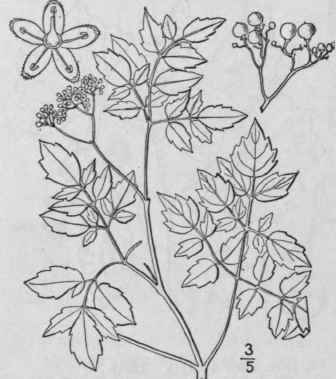
2. Ampelopsis Arbòrea (L.) Rusby. Pepper-Vine. Pinnate-Leaved Ampelopsis
Fig. 2840
Vitis arborea L. Sp. Pl. 203. 1753.
Cissus stans Pers. Syn. 1: 143. 1805.
Vitis bipinnata T. & G. Fl. N. A. 1: 243. 1838.
Ampelopsis arborea Rusby, Mem. Torr. Club 5: 221. 1894.
Glabrous or nearly so, erect or ascending, bushy, sometimes climbing; tendrils often wanting. Leaves bipinnate, or the lowest tripinnate and sometimes 8' in length or more; leaflets ovate or rhombic-ovate, 1/2'-1 1/2' long, sharply serrate, acute or acuminate at the apex, obtuse or slightly cordate or the terminal one cuneate at the base, glabrous, or somewhat pubescent on the veins beneath; panicles short-cymose; corolla expanding; berries black, depressed-globose, about 3" in diameter, sometimes pubescent, the flesh thin, inedible; seeds 1-3.
In rich moist soil, Virginia to Missouri, Florida and Mexico. Cuba. June-July.
Ampelopsis heterophylla (Thunb.) Sieb. & Zucc, a climbing eastern Asiatic vine, with deeply palmately 3-5-lobed leaves and short-peduncled compound cymes, was found as a waif from cultivation at Lancaster, Pa., in 1890.
3. CÍSSUS L. Sp. Pl. 117. 1753.
Mostly climbing vines, sometimes prostrate, the foliage usually succulent. Leaves simple or compound, often trifoliolate, the leaflets readily separating in drying. Flowers mostly perfect. Petals usually 4, spreading. Disk cup-shaped, adnate to the base of the ovary. Berries small, inedible; 1-2-seeded. [Greek, ivy.]
Over 225 species, most abundant in tropical regions. Type species: Cissus vitaginea L.
1. Cissus Incisa (Nutt.) Des Moulins. Cut-Leaved Cissus
Fig. 2841
Vitis incisa Nutt. T. & G. N. A. 1: 243. 1838.
Cissus incisa Des Moulins; Durand, Actes Soc. Linn. Bordeaux 24: [reprint 59]. 1862.
A long vine, the stem and leaves succulent. Leaves 3-foliolate or 3-parted; leaflets or leaf-segments ovate or obovate, cuneate at the base, toothed, or the middle one lobed, 2' long or less; inflorescence umbel-like; berries obovoid, 4" long, nearly black, 1-2-seeded, borne on recurved pedicels.
Sandy and rocky soil, Missouri and Kansas to Texas, Florida and Arizona. June-Aug.

Continue to:


My Books

