


3. Galax L. Sp. Pl. 200. 1753
Description
This section is from the book "An Illustrated Flora Of The Northern United States, Canada And The British Possessions Vol2", by Nathaniel Lord Britton, Addison Brown. Also available from Amazon: An Illustrated Flora of the Northern United States, Canada and the British Possessions. 3 Volume Set..
3. Galax L. Sp. Pl. 200. 1753
An acaulescent perennial herb, with orbicular cordate crenate-dentate long-petioled basal leaves, and numerous small white flowers, spicate-racemose at the ends of tall mostly naked slender scapes. Calyx minutely 2-bracteolate at the base, 5-parted, the sepals nerveless. Corolla 5-divided, the petals oblong, entire, adnate to the bases of the monadelphous stamens. Stamen-tube 10-lobed at the summit, the lobes which are opposite the petals petaloid (staminodia), those alternate with the petals antheriferous; anthers nearly sessile, granular on the back, 1-celled, transversely 2-valvcd. Style very short. Seeds ovoid, the testa loose. [Greek, milk; name not characteristic of this genus.]
A monotypic genus of southeastern North America.
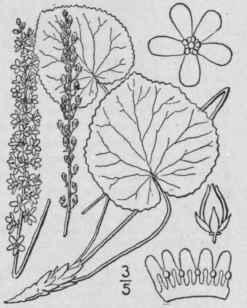
1. Galax AphỳLla L. Galax. Galaxy. Beetle-Weed
Fig. 3280
Galax aphylla L. Sp. Pl. 200. 1753.
Scape 1 1/2° high, terete, with red scaly bracts at the base and many red fibrous roots. Leaves orbicular, or broadly ovate, deeply cordate at the base with a rather narrow sinus, persistent, crenate-dentate or doubly denticulate with mucronulate or rounded teeth, shining, commonly shorter than their slender petioles, 1' - 3' in diameter; spike-like raceme dense, narrow, 2'-5' long; flowers 1 1/2"-2" broad, spreading; bractlets deciduous; capsule ovoid, acute, erect, very short-pedicelled, 1" long, slightly exceeding the lanceolate acutish sepals.
In dry woods, especially in the mountains, Virginia to Georgia. Ascends to 4500 ft. in North Carolina. Leaves bright green, shining. Colt- or colt's-foot. May-July.
Continue to:


My Books

