
![previous page: 48. Phasèolus [Tourn.] L. Sp. Pl. 723. 1753](../../../images/nav/page_prev.gif)


49. Strophostýles Ell. Bot. S. C. & Ga. 2: 229. 1822
Description
This section is from the book "An Illustrated Flora Of The Northern United States, Canada And The British Possessions Vol2", by Nathaniel Lord Britton, Addison Brown. Also available from Amazon: An Illustrated Flora of the Northern United States, Canada and the British Possessions. 3 Volume Set..
49. Strophostýles Ell. Bot. S. C. & Ga. 2: 229. 1822
Twining or trailing herbaceous vines, rarely erect, mostly pubescent, with pinnately 3-foliolate stipellate leaves, and pink-purple or nearly white flowers capitate at the ends of long axillary peduncles. Calyx as in Phaseolus. Standard nearly orbicular;wings mostly obovate; keel strongly curved. Stamens diadelphous (9 and 1). Style longitudinally bearded, bent. Pod linear, nearly terete, or somewhat compressed, usually straight, few-several-seeded, tipped by the persistent style. Seeds truncate at the ends, more or less pubescent or mealy. [Greek, bent style.]
An American genus, of about 6 species. Type species: Strophostyles angulosa Ell.
Leaflets mainly lobed, 1' - 2' long; pod 2'-3' long; root annual. | 1. | S. helvola. |
Leaflets mainly entire, 1/2'-1 1/2' long; pod 1' - 2' long. | ||
Flowers several, about 6" long; root perennial. | 2. | S. umbellata. |
Flowers few, about 3" long; root annual. | 3 | S. paucifiora. |
1. Strophostyles Hèlvola (L.) Britton. Trailing Wild Bean
Fig. 2647
Phaseolus helvolus L. Sp. Pl. 724. 1753. Phaseolus angulosus Ort. Nov. Pl. 24. 1797. Phaseolus diversifolius Pers. Syn. 2: 296. 1807. Strophostyles angulosa Ell. Bot. S. C. 2: 229. 1822. S. helvola Britton; Britt. & Brown, 111. Fl. 2: 338. 1897.
Prostrate or low-twining, rather rough-pubescent, branched at the base, 2°-8° long, rarely erect and 10'-2o' high. Root annual; stipules narrowly lanceolate, 1"-2" long; leaflets broadly ovate, obtuse or acute at the apex, rounded at the base, thickish, generally more or less obtusely lobed, sometimes entire, 1'-2' long, the lower ones often inequilateral; peduncles axillary, exceeding the petioles; flowers 3-10, sessile, capitate; corolla greenish-purple, 4"-6" long; keel slender, curved; pod sessile, linear, nearly terete, slightly pubescent, 2'-3' long; seeds oblong, pubescent, 2 1/2"-3 1/2" long.
In sandy soil, Quebec to Massachusetts, Florida, Ontario, South Dakota, Kansas and Texas. July-Oct.
Strophostyles missouriènsis (S. Wats.) Small, regarded as a variety of this species in our first edition, differs by being a longer vine, climbing over trees and bushes, its leaflets nearly entire and its seeds slightly larger. It ranges from Virginia to Illinois and Kansas.
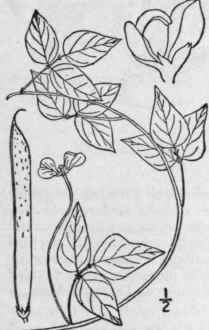
2. Strophostyles Umbellate (Muhl.) Britton. Pink Wild Bean
Fig. 2648
Glycine umbellata Muhl.; Willd. Sp. Pl. 3: 1058. 1803.
Strophostyles peduncularis Ell. Bot. S. C. 2: 230. 1822.
Phaseolus helvolus T. & G. Fl. N. A. 1: 280. 1838. Not L. 1753.
Phaseolus umbellatus Britton, Trans. N. Y. Acad. 9: 10. 1889.
S. timbellata Britton; Britt. & Brown, 111. Fl. 2: 339. 1907.
Root perennial; stems slender, trailing, branching, more or less pubescent with retrorse hairs, 1°-5° long. Stipules ovate-lanceolate, 1"-2" long; leaflets ovate, lanceolate or oblong, obtuse or acutish at the apex, rounded at the base, sparingly pubescent, entire, or rarely with 1 or 2 shallow lobes; peduncles generally much longer than the leaves; flowers several, pink, fading yellowish, capitate-umbellate, about 6" long, similar to those of the preceding species; pedicels 1/2"-1" long; pod linear, straight, little compressed, sessile, 1'-2' long, 2" wide, sparingly pubescent; seeds mealy-pubescent, 1 1/2"-2" long.
In sandy soil, Long Island to Florida, Indiana, Arkansas and Texas. July-Sept.

Continue to:


My Books

