
![previous page: 5. Limnia [L.] Haw. Syn. Pl. Succ. II. 1812](../../../images/nav/page_prev.gif)


6. Portulàca [Tourn.] L. Sp. Pl. 445. 1753
Description
This section is from the book "An Illustrated Flora Of The Northern United States, Canada And The British Possessions Vol2", by Nathaniel Lord Britton, Addison Brown. Also available from Amazon: An Illustrated Flora of the Northern United States, Canada and the British Possessions. 3 Volume Set..
6. Portulàca [Tourn.] L. Sp. Pl. 445. 1753
Diffuse or ascending, glabrous or pubescent fleshy herbs, with terminal flowers. Sepals 2, united at the base and partly adnate to the ovary. Petals 4-6 (mainly 5), inserted on the calyx, fugacious. Stamens 7-°°, also on the calyx. Ovary many-ovuled; style deeply 3-9-cleft or parted Capsule membranous, dehiscent by a lid, many-seeded. [Latin, in allusion to the purging qualities of some species.]
A genus of about 20 species, all but 2 or 3 natives of America. In addition to the following, some 7 others occur in the southern United States. Type species: Portulaca oleracea L.
Leaves mainly rounded at the apex; seeds minutely rugose. | 1. | P. oleracea. |
Leaves mainly retuse; seeds prominently tuberculate. | 2. | P. retusa. |
Pilose-pubescent especially in the axils; leaves terete | ||
Flowers red, 4"-6" broad. | 3. | P. pilosa. |
Flowers variously colored, 1'-2' broad. | 4. | P. grandiftora. |
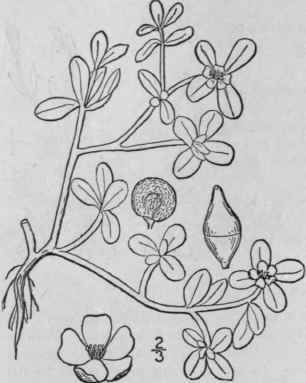
I. Portulaca Oleràcea L. Purslane. Pussley
Fig. 1745
Portulaca oleracea L Sp. Pl. 445. 1753.
Annual, prostrate, freely branching from a deep central root, branches 4'-10' long. Leaves alternate and clustered at the ends of the branches, obovate or cuneate, 3"-10" long, rounded at the apex, very fleshy; flower-buds flat; flowers solitary and sessile, 2"-3" broad, yellow, opening in bright sunshine for a few hours in the morning; sepals broad, keeled, acutish; style 4-6-parted; capsule 3"-5" long; seeds finely rugose, about i" long.
In fields and waste places, nearly throughout our area, and in warm and tropical America. Native in the southwest, but naturalized northward. Widely naturalized as a weed in the warmer parts of the Old World. Summer.
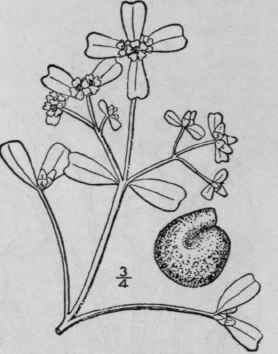
2. Portulaca Retùsa Engelm. Notched Or Western Purslane
Fig. 1746
Portulaca retusa Engelm. Bost. Journ. Nat. Hist. 6: 154. 1850.
Closely resembles the preceding species. Leaves cuneate, generally broader, mostly retuse or emar-ginate, but some of them rounded; sepals broad, obtusish, carinate-winged; style larger, 3-4-cleft; capsule 2"-3" long; seeds distinctly tuberculate, nearly i" long; petals smaller than those of P. oleracea and the flowers opening earlier in the morning than those of that species, where the two grow together.
Minnesota (?), Missouri to Arkansas and Texas, west to Nevada. Growing in large patches, sometimes several feet in diameter. Pigweed. Summer.
Portulaca neglecta Mackenzie & Bush, of Missouri, is described as having larger flowers.
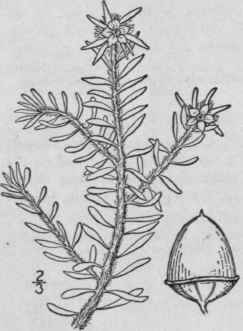
3. Portulaca Pilòsa L. Hairy Portulaca
Fig. 1747
Portulaca pilosa L. Sp. Pl. 445. 1753.
Annual, spreading or ascending from a deep root, more or less densely pilose-pubescent, with small tufts of light-colored hairs in the axils of the leaves. Branches 2'-6' long; leaves linear, terete, obtuse, 4"-8" long, about 1" wide, alternate, and clustered at the ends of the branches; sepals oblong acute, membranous, not carinate, deciduous with the operculum of the capsule; flowers red, 4"-6" broad; stamens numerous; style 5-6-parted; seeds minutely tuberculate.
In dry soil, North Carolina to Florida, Missouri, Kansas, Texas and Mexico. Also in tropical America. Summer.
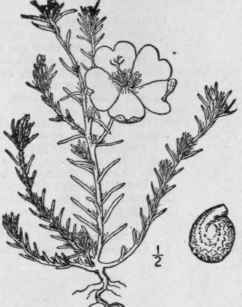
4. Portulaca Grandiflòra Hook. Garden Portu-Laca Or Purslane. Sun-Plant
Fig. 1748
Portulaca grandiflora Hook. Bot. Mag. pl. 2885. 1829.
Ascending or spreading, sometimes densely pilose, but often with but a few scattered hairs and tufts of others in the axils. Branches 6'-12' long; leaves alternate, and clustered at the ends of the branches, terete, 1/2'-1' long, about 1" wide; flowers 1'-2' broad, pink, yellow, red, or white, very showy, open in sunshine only; sepals broad, obtuse, scarious-margined; petals obovate; capsule ovoid; seeds gray, shining.
In waste places, occasionally escaped from gardens. Introduced from South America. Summer. Cultivated in a large number of forms differing in color and size of flowers. Rose- or Kentucky-moss. Showy portulaca. French pussley. Wax-pinks. Mexican rose.
Continue to:


My Books

