


![next page: 2. Viburnum [Tourn.] L. Sp. Pl. 267. 1753](../../../images/nav/page_next.gif)
1. Sambucus [Tourn.] L. Sp. Pl. 269. 1753
Description
This section is from the book "An Illustrated Flora Of The Northern United States, Canada And The British Possessions Vol3", by Nathaniel Lord Britton, Addison Brown. Also available from Amazon: An Illustrated Flora of the Northern United States, Canada and the British Possessions. 3 Volume Set..
1. Sambucus [Tourn.] L. Sp. Pl. 269. 1753
Shrubs or trees (or some exotic species perennial herbs), with opposite pinnate leaves, serrate or laciniate leaflets, and small white or pinkish flowers in compound depressed or thyrsoid cymes. Calyx-tube ovoid or turbinate, 3-5-toothed or 3-5-lobed. Corolla rotate or slightly campanulate, regular, 3-5-lobed. Stamens 5, inserted at the base of the corolla; filaments slender; anthers oblong. Ovary 3-5-celled; style short, 3-parted; ovules 1 in each cavity, pendulous. Drupe berry-like, containing 3-5, 1-seeded nutlets. Endosperm fleshy; embryo nearly as long as the seed. [Latin name of the elder.]
About 25 species, of wide geographic distribution. In addition to the following, about 10 others occur in western North America. Type species: Sambucus nigra L. Cyme convex; fruit purplish black.
1. S. canadensis.
Cyme thyrsoid-paniculate, longer than broad; fruit red.
2. S. racemosa.

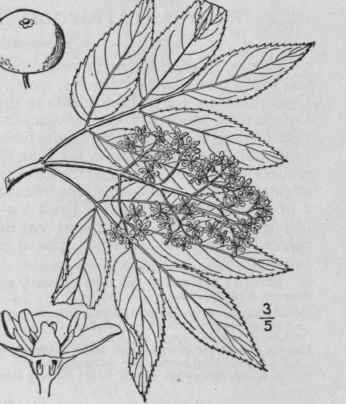
1. Sambucus Canadensis L. American Elder. Sweet Or Common Elder
Fig. 3955
Sambucus canadensis L. Sp. Pl. 269. 1753.
A shrub, 4°-10° high, glabrous or very nearly so, the stems but little woody, the younger ones with large white pith. Leaflets 5-11, usually 7, ovate or oval, acuminate or acute at the apex, short-stalked, glabrous above, sometimes pubescent beneath, 2'-5' long, sharply serrate, sometimes stipellate; cymes convex, broader than high; flowers white, about \\" broad; drupe deep purple or black, nearly 3" in diameter; nutlets roughened.
In moist soil, Nova Scotia to Florida, west to Manitoba, Kansas and Texas. Also in the West Indies. Ascends to 4000 ft. in North Carolina. Called also elder-blow, elder-berry. The flowers and fruit have strong medicinal properties. Leaves heavy-scented when crushed, those of young shoots often stipulate. June-July.
2. Sambucus Racemosa L. Red-Berried Elder
Fig. 3956
S. racemosa L. Sp. Pl. 270. 1753.
S. pubens Michx. Fl. Bor. Am. 1: 181. 1803.
A shrub, 2°-12° high, the twigs and leaves commonly pubescent; stems woody, the younger with reddish-brown pith. Leaflets 5-7, ovate-lanceolate or oval, acuminate at the apex, often narrowed and usually inequilateral at the base, 2'-5' long, not stipellate, sharply serrate; cymes thyrsoid, longer than broad; flowers whitish, turning brown in drying; drupe scarlet or red, 2"-3" in diameter; nutlets very minutely roughened.
In rocky places, Newfoundland to Alaska, British Columbia, Georgia, Michigan, Colorado and California. Fruit rarely white. April-May. Called also mountain elder. Poison-elder (Me.). Boor- or bore-tree. Boutry. Ascends to 5000 ft. in Virginia. Sambucus pubens dissecta Britton, Mem. Torr. Club 5: 304. 1894, is a race with leaflets laciniate. Lake Superior and Pennsylvania.
Sambucus laciniata Mill., a cut-leaved race of the related European 5. nigra L., has been found at Cape May, N. J., perhaps escaped from cultivation.
Continue to:


My Books

