


30. Sericocarpus Nees, Gen. & Sp. Ast. 148. 1833
Description
This section is from the book "An Illustrated Flora Of The Northern United States, Canada And The British Possessions Vol3", by Nathaniel Lord Britton, Addison Brown. Also available from Amazon: An Illustrated Flora of the Northern United States, Canada and the British Possessions. 3 Volume Set..
30. Sericocarpus Nees, Gen. & Sp. Ast. 148. 1833
Erect perennial herbs, with alternate leaves, and middle-sized heads of both tubular and radiate flowers, in terminal cymose panicles. Involucre ovoid, oblong, or campanulate, its bracts coriaceous, with herbaceous or squarrose tips, imbricated in several series, the outer shorter. Receptacle small, foveolate. Ray-flowers white, pistillate. Disk-flowers mostly perfect, their corollas tubular, narrow, yellowish or purplish, 5-lobed. Anthers obtuse and entire at the base. Style-branches with lanceolate-subulate appendages. Achenes slightly compressed, linear-oblong, 1-nerved on each side, pubescent. Pappus of numerous capillary scabrous bristles, the outer usually shorter. [Greek, silky fruit, referring to the achenes.]
Four known species, natives of North America. Besides the following, another occurs on the northwestern coast of North America. Type species: Sericocarpus solidagineus (Michx.) Nees. Leaves entire, linear, spatulate, or obovate, rigid.
Glabrous, or nearly so; leaves linear or linear-spatulate.
1. S. Iinifolius.
Puberulent or scabrous; leaves obovate.
2. S. bifoliatus.
Leaves dentate, oblong, or obovate, thin.
3. 5. asteroides.
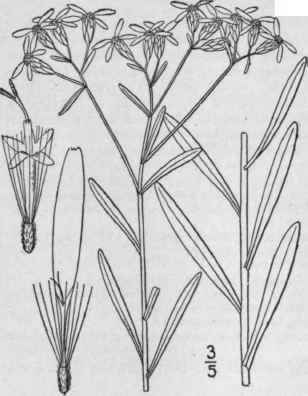
1. Sericocarpus Linifolius (L.) B.S.P. Narrow-Leaved White-Topped Aster
Fig. 4279
Conyza lintfolia L. Sp. Pl. 861. 1753.
Aster solidagineus Michx. Fl. Bor. Am. 2: 108.
1803. Sericocarpus solidagineus Nees, Gen. & Sp. Ast.
149. 1832. Sericocarpus linifolius B.S.P. Prel. Cat. N. Y. 26.
1888.
Glabrous or very nearly so throughout; stem rather slender, striate, 1°-2 1/2° high. Leaves linear or linear-spatulate, spreading, faintly 3-nerved, thick, entire, obtuse at the apex, narrowed at the base, 1'-2' long, 1 1/2"-3" wide, sessile, or the lowest on short margined petioles, their margins scabrous; heads about 3"-4" high, clustered in 2's-6's at the ends of the cymose branches; involucre oblong-campanu-late, 2"-3 1/2" long, its bracts oblong, obtuse, the outer with somewhat spreading or reflexed green tips, the inner scarious and often lacerate or ciliate at the apex; rays 4 or 5, about 5" long; pappus white.
In dry, usually sandy soil, Maine to Ohio, Georgia and Louisiana. Erroneously recorded from Canada. June-Sept.

2. Sericocarpus Bifoliatus (Walt.) Porter. Rough White-Topped Or Silk-Seed- Aster
Fig. 4280
Conyza bifoliata Walt. Fl. Car. 204. 1788.
Aster tortifolius Michx. Fl. Bor. Am. 2: 109. 1803.
S. tortifolius Nees, Gen. & Sp. Ast. 151. 1832.
S. bifoliatus Porter, Mem. Torr. Club 5: 322. 1894.
Densely puberulent or scabrous, about 2° high, the stem terete, or slightly angled. Leaves sessile, obscurely veined, obovate or broadly spatulate, thick, obtuse, ascending or erect by a twist at the base, 1/2'-1' long, 4"-8" wide, entire, mucronulate, densely appressed-puberulent on both sides, the upper mostly oblong, much smaller; heads 4"-5" high, cymose-paniculate; involucre narrowly campanulate, its bracts oblong or the inner linear, pubescent, their tips somewhat spreading; rays short; pappus white.
In dry soil, Virginia to Florida and Louisiana, mainly near the coast. Rattlesnake-master. July-Sept.
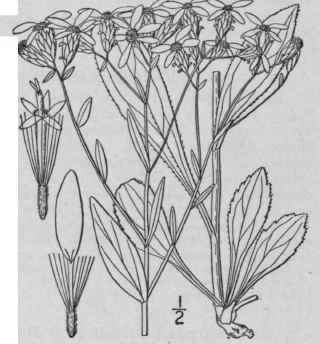
3. Sericocarpus Asteroides (L.) B.S.P. Toothed White-Topped Aster. Fig 4281
Conyza asteroides L. Sp. Pl. 861. 1753.
S. conysoides Nees, Gen. & Sp. Ast. 150. 1832.
S. asteroides B.S.P. Prel. Cat. N. Y. 26. 1888.
Stem pubescent, or glabrate, slightly angled, 1°-2° high. Leaves thin, pubescent or glabrous, ciliate, pinnately veined and faintly 3-nerved, the basal and lower ones obovate or spatulate, dentate or rarely entire, 2'-4' long, 1'-1 1/2' wide, narrowed into margined petioles; upper leaves oblong or oblong-lanceolate, entire or dentate, acute or obtuse, smaller; heads 5"-6" high, densely clustered; involucre campanulate, its bracts oblong, ciliate or pubescent, the outer with green reflexed tips; pappus brown or white.
In dry woods, Maine to Florida, west to Ohio, Kentucky and Alabama. July-Sept.
Continue to:


My Books

