


31. Aster L. Sp. Pl. 872. 1753. Part 18
Description
This section is from the book "An Illustrated Flora Of The Northern United States, Canada And The British Possessions Vol3", by Nathaniel Lord Britton, Addison Brown. Also available from Amazon: An Illustrated Flora of the Northern United States, Canada and the British Possessions. 3 Volume Set..
31. Aster L. Sp. Pl. 872. 1753. Part 18
57. Aster Commutatus (T. & G.) A. Gray. White Prairie Aster
Fig. 4338
Aster ramulosus var. incanopilosus Lindl. in DC. Prodr. 5:
243. 1836. Aster multiflorus var. commutatus T. & G. Fl. N. A. 2: 125.
1841. Aster commutatus A. Gray, Syn. Fl. 1: Part 2, 185. 1884. A. incanopilosus Sheldon, Bull. Torr. Club 20: 286. 1893.
Similar to the preceding species, except in the inflorescence, the stem rough-pubescent, or sometimes nearly glabrous, l 1/2°-2 1/2° high, with ascending or divergent branches. Leaves linear or linear-oblong, obtuse, entire, sessile or slightly clasping at the base, those of the stem 1'-3' long; heads larger than those of A. multiflorus, 6"-8" broad; involucre 3"-4" high, its ciliate bracts squarrose-tipped and sometimes foliaceous; rays 20-30, about 3" long.
On prairies and along rivers, Minnesota to Saskatchewan, Nebraska, Texas and New Mexico. Aug.-Oct.
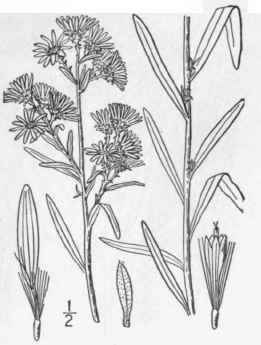
58. Aster Dumosus L. Bushy Aster. Rice-Button Aster
Fig. 4339
Aster dumosus L. Sp. Pl. 873. 1753.
Aster coridifolius Michx.; Willd. Sp. Pl. 3: 2028. 1804.
Aster dumosus strictior T. & G. Fl. N. A. 2: 128. 1841.
Aster dumosus coridifolius T.&G. Fl. N. A. 2:128. 1841.
Glabrous or nearly so throughout, rather stiff and viscid, usually paniculately branched, 1°-3° high. Leaves firm, those of the stem linear or linear-lanceolate, entire, acute, or obtusish, l'-3' long, 11/2"-3" wide, roughish-margined, often reflexed, those of the branches very numerous, small and bract-like, the basal ones spatulate, dentate; heads 4"-7" broad, terminating the slender minutely leafy branches and branchlets, usually numerous; involucre broadly campanulate, its bracts linear-subulate, obtuse or acutish, appressed, imbricated in about 4 series, green-tipped; rays 15-30, blue to pale violet or white, 2"-4" long; pappus white; achenes pubescent.
Sandy soil, Massachusetts to western New York, Ontario, Florida, Louisiana and Missouri. Aug.-Oct.
Aster Gravesii Burgess, known only from Water-ford, Conn., has oblong-la'nceolate leaves, acuminate at both ends, the larger 8" wide, the rays bright purple.
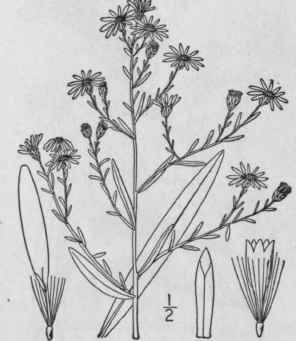
59. Aster Salicifolius Lam. Willow Aster
Fig. 4340
Aster salicifolius Lam. Encycl. 1: 306. 1783. Aster subasper Lindl. Comp. Bot. Mag. 1: 97. 1835. Aster stenophyllus Lindl. DC. Prodr. 5: 242. 1836. Aster salicifolius subasper A. Gray, Syn. Fl. 1: Part 2, 188. 1884.
Stem rather slender, paniculately much branched, usually very leafy, 2°-5° high, glabrous, roughish or somewhat pubescent above. Leaves firm, lanceolate or linear-lanceolate, roughish or rough-margined, acute or acuminate at the apex, narrowed and sessile or slightly clasping at the base, entire or sparingly dentate with low teeth, glabrous or nearly so, 2'-4 long, 2"-6" wide, the lowest sometimes petioled, those of the branches gradually smaller; heads numerous, 8"-12" broad; involucre 3"-4" high, its bracts linear-oblong, appressed, imbricated in 4 or 5 series, their green tips acute or obtusish; rays numerous, violet, or violet-purple, or sometimes white, 3"-4" long; pappus white; achenes pubescent.
In moist soil, Maine to Massachusetts, Florida, Ontario, Assiniboia, Texas and Colorado. Aug.-Oct.


Continue to:


My Books

