


Lopseed Family - Phrymaceae - Lopseed - Phryma Leptostachya Linnaeus - Plate 208
Description
This section is from the book "Wild Flowers Of New York", by Homer D. House. Also available from Amazon: Wild Flowers Of New York.
Lopseed Family - Phrymaceae - Lopseed - Phryma Leptostachya Linnaeus - Plate 208
A rather slender, perennial herb with erect, puberulent, somewhat four-angled stem, branched above, 1 to 3 feet high, the branches slender and opposite. Leaves opposite, thin, ovate, pointed at the apex, coarsely toothed, the lower ones long petioled, the upper ones short petioled or sessile, 2 to 5 inches long. Flowers small, about one-fourth of an inch long, in narrow spikes terminating the stem and branches, usually the flowers opposite each other. Calyx cylindrical, two-lipped, the upper lip cleft into three long bristle or hairlike teeth, the lower lip divided into two short, slender teeth. Corolla tube cylindrical, two-lipped, pinkish purple, the upper lip erect, concave and notched, the lower lip larger and divided into three spreading, convex and blunt lobes. Stamens four, included within the tube of the corolla. Flowers erect at first, soon becoming at right angles to the stem when in full bloom and later as the fruit matures becoming abruptly deflexed against the axis of the stem, whence the name " lopseed."
In woods and thickets, New Brunswick to Manitoba, south to Florida and Kansas; also in Bermuda and eastern Asia. Flowering from June to August.
Memoir 15 N. Y. State Museum
Plate 208
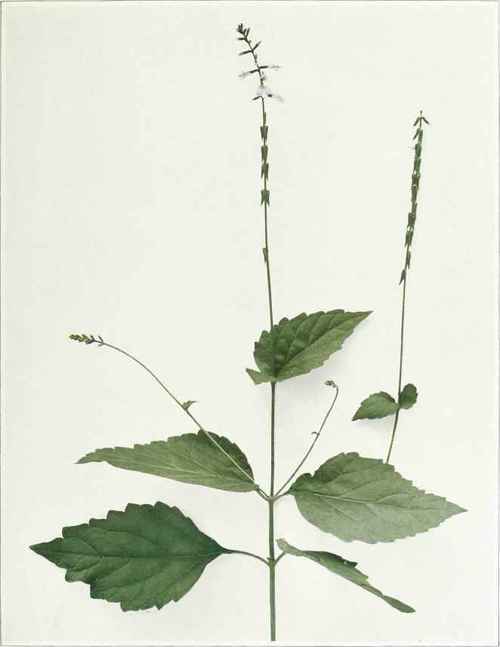
Lopseed - Phryma leptostachya
Continue to:


My Books

