


Bulbous Water Hemlock (Cicuta Bulbifera L.) Carrot Family - Plate XXVIII
Description
This section is from the book "Principal Poisonous Plants Of Canada", by Faith Fyles. Also available from Amazon: Principal poisonous plants of Canada.
This section is from the "" book, by .
Bulbous Water Hemlock (Cicuta Bulbifera L.) Carrot Family - Plate XXVIII
Description
The bulbous water hemlock is a slender perennial plant, much branched, growing from one to three feet high. The leaves are divided two or three times into narrow, saw-toothed leaflets. The upper leaves are less divided and bear small clustered bulblets in the angles formed by the leaf and stem. The white flower clusters are arranged in umbels similar to those of the other water hemlocks. The roots also are similar but seldom as large. It is in bloom from July to September.
Distribution
It is found in swamps and wet places from Nova Scotia to British Columbia.
Poisonous Properties
This species and also the Western Water Hemlock (Cicuta vagans Greene) of British Columbia, contain the same poisonous principles as the preceding species and are equally dangerous to all stock. Plate XXIX.
Remedy And Means Of Control
The poisonous substance of the water hemlocks is so rapid in its action that little or nothing can be done in the way of remedial treatment. When poisoning has been discovered the animals are either dead or dying or in such excitement that any attempt at treatment tends to hasten death.
Plate XXVIII.

Photo - P. Fyles.
Bulbous Water Hemlock.
Plate XXIX.
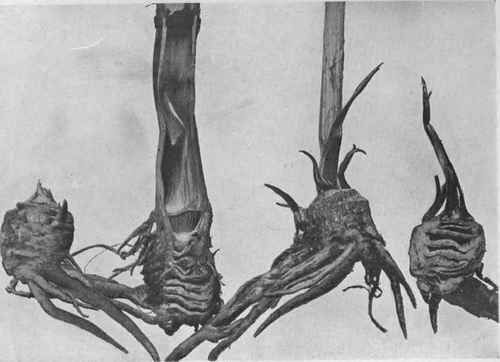
Photo - F. Fyles.
Western Water Hemlock.
In the case of human poisoning an emetic may be given at once and a physician summoned.
All plants should be grubbed out and destroyed, or they may be readily pulled by hand in the spring when the ground is soft. On large areas where grubbing out seems impossible, the land should not be used as a pasture.
Continue to:


My Books

