


Massage: Synovitis Of The Knee
Description
This section is from the book "Lessons on Massage", by Margaret D. Palmer. Also available from Amazon: The Book Of Massage: The Complete Stepbystep Guide To Eastern And Western Technique.
Massage: Synovitis Of The Knee
In synovitis of the knee there is very extensive swelling, because of the large synovial membrane, and many bursae. The membrane lines the capsular ligament, covers the semilunar cartilages, surrounds the crucial ligaments, goes up the femur under the quadriceps extensor, and reaches below the patella. There are several bursae in the neighbourhood of the joint, one between the patella and the skin over it. This one is subject to inflammation from much kneeling. It does not communicate with the joint. There are several in the popliteal space, some of which communicate with the joint. When, owing to injury, the synovial fluid is poured out in undue quantities, these bursae can be defined, and the patella felt to ride on the fluid. All this swelling and fluid means pain from the pressure on sensory nerves and stretching of ligaments. The chief use of massage at this stage is to help in the absorption of fluid, and thus relieve tension.
Effleurage of thigh for five minutes, to be followed by movements for knee (described in Chapter VII.), applied superficially. Passive movements (extension and flexion) give much pain, and should be very gently done. Many accidents happen to the knee, but the treatment is the same. In each case the object is to reduce swelling, to strengthen the joint, to improve the muscles, and to restore movement. Absorption of fluid is helped by squeezing ; the limb is grasped above and below the patella, and intermittent pressure given with both hands ; the hands are then pressed towards each other. After the swelling is reduced, and the knee fairly well, there is still thickening of tissue, which is got under by friction.
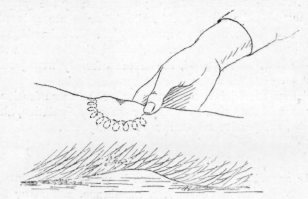
Fig. 104.—Friction Round the Knee.
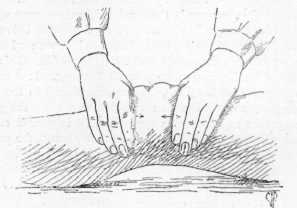
Fig. 105.—Squeezing the Knee to reduce Swelling.
Massage should not be applied directly to a joint while there is inflammation, but above it. It may be hours or days before the joint itself may be manipulated. Increased heat or swelling after massage of a joint would indicate that the treatment should be suspended.
However painful flexion and extension of a joint may be at the moment, it should almost immediately subside. If the pain continue for hours, advice should be sought, as formation of pus or diseased bone might be present. In chronic cases the joints can be freely handled. In knee troubles the extensor muscles of the thigh waste quickly, and should be thoroughly well masséed. All the thigh muscles should have attention, as it is as important to improve their condition as to restore the movement of the knee.

Fig. 106 —Flexing the Leg.
The remarks as to bandages, etc., apply to all joints.
Joints are well supplied with bloodvessels and lymphatics. When a joint is congested and inflamed, the object in giving massage above it is to relieve the over-charged vessels. Manipulation of the joint would cause pain and increase local circulation, two things to be avoided.
Continue to:


My Books

