


The Trunk Bones
Description
This section is from the book "Lessons on Massage", by Margaret D. Palmer. Also available from Amazon: The Book Of Massage: The Complete Stepbystep Guide To Eastern And Western Technique.
The Trunk Bones
Spinal Column.
Ribs.
Sternum.
Pelvis.
The spinal column is composed of thirty-three vertebrae :
7 Cervical (neck).
12 Dorsal (back).
5 Lumbar (loins).
5 Sacral (rump).
4 Coccygeal (tail).
Each vertebra consists of an anterior solid portion called the body, and a posterior portion called the arch. Each arch has one spinous, two transverse and four articular processes. The spinous processes project directly backward, and serve for •the attachment of muscles. The transverse processes stand out from the sides of the arch at right angles, and also serve for the attachment of muscles. The articular processes stand out obliquely from the arch above and below; the vertebrae are joined by these articular processes.
The plates of bone which form the roof of the arch are called laminae.
The vertebrae are not all the same, but they are all formed after the same plan, each one having a body, seven processes, two laminae, two pedicles, and a foramen, except the first cervical, which is little more than a ring. It is called the atlas, because it supports the head ; and the second cervical which has a toothlike projection called the odontoid peg, supposed to be the detached body of the atlas, is called the axis. Round this peg the atlas and head turn, forming a pivot joint. Two spaces are formed in the atlas by a ligament ; the anterior space receives the projection of the axis, the spinal cord passes through the posterior space.

Fig. 63.—Spinal Column.
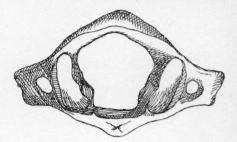
Fig. 64.—First Cervical Vertebra.

Fig. 65.—Second Cervical Vertebra (from Above).
1. Odontoid peg.

Fig. 66.—Second Cervical Vertebra (from the Side).
1, Odontoid peg.
The odontoid peg is attached to the occiput by ligaments. There are two synovial membranes, one in front and one behind the peg.
The nodding movement of the head takes place between the occiput and the articular processes of the atlas. Rotation of the head is the movement of the atlas round the axis ; thus there is a hinge as well as a pivot joint. Too great rotation is checked by certain ligaments.
The cervical vertebrae are the smallest ; the seventh is called vertebra prominans, because of its long spinous process.
The dorsal vertebras are larger than the cervical. They have facets for the articulation of the ribs.
The lumbar vertebrae are the largest and strongest.
The sacral vertebrae are fused together into a solid bone, as also are the coccygeal, in the adult.
The upper twenty-four vertebrae have intervertebral discs of cartilages, which act as buffers in counteracting shocks, and also give freedom of movement. The movement is more free where the discs are thicker in the lumbar and cervical regions. The discs of cartillage comprise one-fourth of the length of the spinal column.
The posterior portion of the spinal column is called variously the spinal canal, the neural arch, and vertebral foramen. The spinal cord passes through it, and the spinal nerves pass out from it through the spaces between the vertebras.
The spinal column has four natural curves. The convexity is forward in the cervical and lumbar regions, and backward in the dorsal and coccygeal regions.
Ribs.—There are twelve ribs on each side ; the seven upper are true ribs connected with the sternum by their own cartilages. The remaining five are false ribs, three of them are connected indirectly with the sternum by their cartilages, being; attached each to the one above it. The last two ribs have no sternal attachment, and are floating ribs.
A rib has a shaft, or body, and two extremities. The vertebral end consists of a head, neck and tubercle.
The facets on the transverse processes of the upper ten dorsal vertebrae are covered with cartilage, and articulate with the tubercles of the ten corresponding ribs. The two lower ribs have no tubercles, and do not articulate with the transverse processes. Each rib from the second to the ninth articulates also with the bodies of the vertebrae and the intervening cartilage by its head. The heads of the remaining four ribs join directly with the corresponding vertebrae. The eight ribs between the first and the tenth have two synovial membranes each.
The sternum or breast-bone is in the middle line in the front of the chest. It is likened to a sword—the upper part is called the manubrium, or handle, the middle part, or body, the gladiolus, and the lower part the ensiform or xyphoid process ; these three parts are also described as presternum, mesosternum and xyphis sternum. At the sides are notches for union with the cartilages -of the seven upper ribs.

Fig. 67.—Sternum.
The contents of the abdomen are supported by, and the weight of the body transmitted to, the lower limbs by the pelvis. It is formed by the union of the innominate bones with the sacrum and coccyx.

Fig. 68.—The Pelvis.
1, Crest of ilium; 2, ilium; 3, sacrum; 4, pubes ; 5, superior anterior spine; 6, inferior anterior spine of ilium ; 7, acetabulum ; 8, ischium; 9, obturator foramen.
The sacrum consists of five bones of the spinal column, fused together and forming one firm bone. The spinal canal is continued into it, and there are several holes at the side through which nerves pass out.
The coccyx is an appendage of the sacrum, and consists of four rudimentary bones fused together. It is the terminal part of the spinal column.
The innominate bone is composed of three parts in the child, but united in the adult, though it retains the original names— the ilium, the ischium, and the pubis.
The ilium is the upper expanded portion, and is the flank of haunch-bone. It articulates with the sacrum. Plates of cartilage, with synovial membrane between, unite the two bones. This joint is called the sacro-iliac synchondrosis ; it is slightly movable.
The round, thick border is called the crest of the ilium, from which several muscles arise ; the anterior and rather hollowed part is the iliac fossa. The two prominences in front are the anterior superior and the anterior inferior spines of the ilium ; three prominences at the back are the posterior superior and posterior inferior spines of the ilium, and the spine of the ischium.
The two notches at the back are the great sciatic notch below the inferior spine, and the lesser sciatic below the spine of the ischium.
The ischium is the lowest and back part of the innominate bone. A rough prominence, the tuberosity of the ischium, is the part on which we sit ; the part which curves upwards and forwards is the ramus of the ischium. Just above the tuberosity is a large hole called the thyroid or obturator foramen ; the obturator membrane is stretched across it, leaving a space for the passage of obturator nerves and bloodvessels.
The pubis is the fore part of the innominate bone. It is joined to its fellow of the opposite side by a plate of fibro-cartilage, forming a joint called the symphysis pubis.
The descending part is called the descending ramus of the pubis. It joins the ramus of the ischium. The part at which these three bones unite forms the socket into which the head of the femur is received, and which forms the hip-joint. It is called the acetabulum or cotyloid cavity.
The top of the symphysis is the crest of the pubis, the sloping part above it is the horizontal ramus.
Continue to:


My Books

