


Metalworking Tools And Their Uses (Fig. 16). Continued
Description
This section is from the book "Handcraft In Wood And Metal", by John Hooper, Alfred J. Shirley. Also available from Amazon: Handcraft In Wood And Metal.
Metalworking Tools And Their Uses (Fig. 16). Continued
(13) Star Hack Saw
Used for steel and iron as well as other metals. Frame of cast-iron, blades 8 in. long, hardened, cannot be filed. Teeth 14 to the inch. Can also be had with twenty-three teeth per in.
(14) Hack Saw Blade-Measurements taken over all. Sometimes tempered so that they can be filed, or hardened so that they cannot be filed, or hard teeth with soft backs.
(15) Steel Try Square
Made of all iron or steel, sometimes with or without measurements, hardened or soft.
(16) Imperial Standard Wire Gauge
One of the gauges used in measuring the various thicknesses of metal. Made of steel and hardened and tempered. Not used for steel wire, lead, zinc, silver, or gold.
The tools illustrated on Fig. 18 are as follows:-
(1) Double-Handed Tap Wrench
Used generally for turning a tap. Holes made to suit various sized tap heads. Made of iron or steel.
(2) Adjustable Tap Wrench
Used for the same purposes as No. 1, with the exception that adjustment is obtained by turning the right-hand handle which has a hole for a lever to assist in tightening.
(3) Single-Ended Spanner
Used for turning bolts and nuts. Made of malleable iron with case-hardened jaws.
(4) Double-Ended Spanner
Used for the same purpose as No. 3.
(5) Stillson Wrench
Really an adjustable spanner with teeth; the more pressure put on the handle the tighter the grip in the jaws. The teeth are in opposite directions, and they mark the object being held.
(6) Double-Action Coach Wrench
Also an adjustable spanner, but the jaws open and close very quickly, owing to the two screws which are right and left handed; also a better grip of the object being held in the jaws can be obtained. Sometimes called a monkey wrench.
(7) Stocks And Dies
The stock is that portion with handles which holds the dies. The dies are adjustable by means of the set screw, and a number of sets of dies are usually supplied with the stocks. These are used for outside screwing of all sorts up to the capacity of the stocks.
(8) Stocks And Dies
Sometimes called fine dies for brass, as they are usually used for screwing brass and copper tube, and the thread is twenty-six to the inch. This thread is used largely in brass work. The dies are for three different sizes and denote the outside diameter of finished work. There is also a wheel for cutting off thin tube, which, like the dies, is adjustable by means of a thumbscrew.
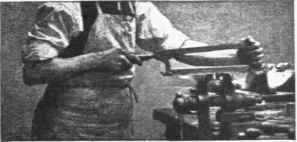
Fig. 17.-Method of holding a hack saw.

Fig. 18.-Metalworker's tools.
Description of Fig. 18 {continued).
(9) Stocks And Dies
Sometimes called B.A. stocks and dies (B.A. means British Association). Stocks are usually of gunmetal, and the die is in one piece. A saw-cut is put in one side of die and a small set screw to allow a small adjustment by means of the springiness of the die to compensate for wear. The dies are held in their place by means of the milled-headed set screw shown, and sizes are known by number from 0 to 10, 0 being the largest. This is the B.A. standard.
(10) Circular Split Die
This is the die used in the stocks of No. 9.
(11) Double-Handed Screw Plate
A piece of flat steel, pierced, tapped, hardened, and tempered, for screwing pins by once running down. Made largely to suit Whitworth standardized threads.
(12) Inside Chaser
Sometimes called inside screwing tool, or inside comb chaser. Made in all pitches for screwing internal vee threads; it has to be fixed into a handle and used by hand.
(13) Outside Chaser
Used for cutting external threads of all kinds and sizes. Makes a pair with (12).
(14) Plug Or Bottoming Tap
The one illustrated is a 3/8 in. fine thread, that is twenty-six to the inch.
(15) Taper Tap
Makes a pair with (14), and this pair with the remaining ones for 1/2 in. and 5/8 in. would make a set with the stocks and dies (8).
(16) First Taper Tap.
(17) Second Taper Tap.
(18) Plug Or Bottoming Tap
These three form a set of taps and are of one size and pitch. Used in combination with the stocks and dies (7).
(19) A Wire Tap
Made only in small sizes; it does away with the necessity for using a tap wrench.
(20) A Reamer Or Rimer
Made in all sizes, and used for enlarging holes. The ends are made tapered and squared so that they can be turned by means of a tap wrench or used in a fitter's brace, illustrated in Fig. 20 (9).
(21) Broach
Has five flat sides. Used for enlarging holes.
(22) Milling Tool
Sometimes called knurling tool, consisting of a knurling wheel which runs on a hardened pin in an iron holder. Used by pressing against the work, which is revolved in lathe, when the knurling wheel cuts a pattern on the work.
(23) A Pearling Wheel
Used in the same manner as a knurling wheel, but mostly used to decorate, or put a series of pearls or beads on a circular object.
(24, 25, 26) Knurling Wheels
Used in the holder (22). Made of steel and hardened.
(27) Lancashire Hand Vice
Used for holding work in the hand or for holding templets to metal while the metal is being marked out. Sometimes made of all steel or of wrought iron with jaws faced with steel.
Continue to:


My Books

