


Chapter IV. Roof Frame: Any Polygon. 30. Tangents; Miter Cuts Of The Plate
Description
This section is from the book "Carpentry", by Ira Samuel Griffith. Also available from Amazon: Carpentry.
Chapter IV. Roof Frame: Any Polygon. 30. Tangents; Miter Cuts Of The Plate
Tangents; Miter Cuts Of The Plate. Before the principles involved in the laying out of rafters on any type of roof can be understood, a clearer idea of the term tangent as used in roof framing must be had. A tangent of an angle of a right triangle is the ratio or fractional value obtained by dividing the value of the side opposite that angle by the value of the adjacent side. The tangent at the plate, to which reference was made is the tangent of the angle having for its adjacent sides the run of the common rafter and the run of the hip or valley. By making use of a circle with a radius of 12" we may represent the value of this tangent graphically in terms of the constant of common rafter run, Fig. 68. By constructing these figures very carefully and measuring the line marked tangent, we may obtain the value of the tangent for the polygon measured in inches to the foot of run of the common rafter. Such measurements, if made to the 1/100 of an inch will serve all practical purposes. A safer way, however, is to make use of values secured thru the trigonometric solutions described in Appendix I, using the graphic solutions as checks. The values of tangents at intervals of one degree are given in the Table of Natural
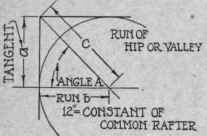
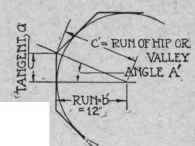
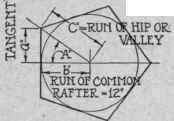
Fig. 68. Tangents.

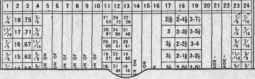
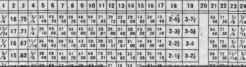
Fig. 69-a. Table of Tangents.

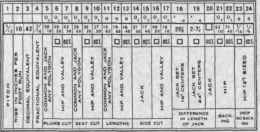
Fig. 69-b. Rafter Table..
Functions, Appendix II. By interpolation, fractional degree values may be found.
Example:
Find the value of the tangent for an octagonal plate. Solution:
Angle A' of Fig. 68 = 22½°
(1/16 of the sum of all the angles about a point)
Tan 22½° = .4143
Tables are builded with 1 as a base. In roof framing 1' or 12" is taken as the constant or base, or unit of run of common rafter. .4143 may be considered as feet, which equals 4.97". In a similar manner tangents may be found for plates of buildings of any number of sides.
In Fig. 69 is illustrated a handy device one side of which, by the twirling of one disk within the other, can be made to give tangent values, in terms of a 12" base, for any number of degrees. The reverse side of this "key" gives data to be used in the framing of square cornered and octagonal roofs. Such a key will be found a convenient way in which to carry needed data and should be easily understood and intelligently used, once the principles discussed in this chapter are mastered. An explanation of the author's key, Fig. 70, will be found in Appendix IV.
Now as to some of the uses for tangent values: First, by taking 12" on the tongue and the tangent value in inches per foot of common rafter run upon the blade of the square, we are able to get the lay-out for the miter joint of the plate.
Fig. 71-b illustrates the square placed for the lay-out of the octagonal plate or sill miter. Five inches is taken as tangent since the real value 4.97" is equivalent to 5" for all practical purposes.
For the square cornered building 12" and 12" would be used in making the plate miter lay-out, since the tangent of 45° is 1 according to the Table, Appendix II. Any other like numbers would give a tangent value of 1, of course, but it is best to consider 12" on the tongue, in which case 12" must be taken on the blade.
Second, this tangent value is needed in determining the cheek or side cut of hip, valley and jack rafters, as will be shown in Sec. 35.
Third, this tangent value is needed in determining the amount of backing to be given hip rafters. This is discussed in Sec. 39.
Not infrequently the plate miter in degrees is required. This is determined for any regular polygon by the proposition: The central angle plate or miter angle of any regular polygon = 90° 2
Example: ' Find the value of the plate miter of the octagon.
Solution:
The octagon has 8 sides; therefore central angle = 45° 45° ÷ 2 = 22½° 90° - 22½° = 67½°
Steel Square
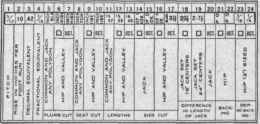
Miter Cut Of Plate
MITER CUT OF PLATE | |||||
POLYGON | TONG | BLADE | POLYGON | TONG | BLADE |
3 Sides | 12" | 20 | 8 Sides | 12" | 5 |
♦ - | 12 | 9 • | - | 4½ | |
5 - | - | 10 " | 3½ | ||
6 - | - | 6½ | 11 " | - | 3½ |
7 - | ■■ | 5½ | 12 " | ■■ | 3i |
SCRIBE ON BLADE | |||||
LENGTH OF SIDE = 2 X RUN x BLADE + 12 | |||||
Griffith's Roof Framing Tables For Steel Square
IRA S GRIFFITH published by The Manual Arts Press peoria illinois
Fig. 70-a. PROTRACTOR
Miter Cut Of Plate
MITER CUT OF PLATE | |||||
POLYGON | ANGLE | COTANGENT | polygon | ANGLE | COTANGENT |
3sides | 30° | 1 732 | 8 sides | 67½ | 414 |
4 - | 45 | 1 000 | » - | 70 | 364 |
5 " | » | 727 | 10 " | 72 | 325 |
i - | 60 | .577 | II | 73 7/12 | 295 |
7 - | 644 | .482 | 12 " | 75 | 268 |
LENGTH OF SIDE = 2 X RUN x COTANGENT | |||||
Griffiths Roof Framing Tables For protractor
IRA S GRIFFITH published by The Manual Arts Press peorma illanons
Fig. 70-b.
Griffith's Roof Framing Tables
Fourth, the tangent value is needed in finding the length of a side of a polygon, the span or run of the polygon being known, and vice versa. Length of side = span x tangent of plate, using 12" as base.
Example:
An octagonal silo has a span of 18'; determine the length of plate for any side.
Solution:
The tangent value of the octagon = 4.97" (to each 12" of run) 18 X 4.97" = 89.46" = 7' 5.46" = 7' 5½".
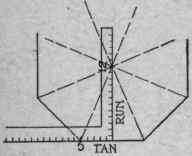
Fig. 71-a..
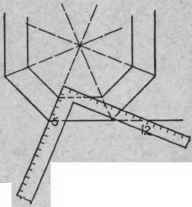
Fig. 71-b..
Laying out Miters
Example:
A side of a hexagon measures 4'; determine the run of the hexagon.
Solution:
Transposing the rule above: Span = length of side divided by tangent of plate. Tangent of hexagon = 6.92" when base = 12". 4' divided by 6.92" = 6' 6.48" = span. Run = 3' 3.24".
Continue to:


My Books

