


Phrasing
Description
This section is from the book "Phonetic Shorthand", by William W. Osgoodby. Also available from Amazon: Phonetic Shorthand.
Phrasing
Sec. 27. The student will have noticed that there are two kinds of phrase-writing taught in the rules heretofore given - Simple Phrasing, which is the joining of two or more outlines; and Group Phrasing, which is the representation of phrases by the use of hooks, circles, or loops, attached to a word-sign, or by the halving or lengthening principles. As to either method, the following directions should be carefully observed: a. Such words only should be joined as have a close grammatical relation to each other.
b. If the elements of a phrase cannot be easily and readily joined, or if for any reason they would not be distinct when joined, the combination should not be made.
c. Two distinct phrases should not be joined together.
d. Two large hooks should not be written on the same side of a straight stem, in phrasing, as they would have a tendency to curve the stem; and no hook can be used to add a word to a stem which is halved or lengthened for a preceding word.
e. Unusual phrases, as come what will, should not be joined.
f. When a phrase begins with the tick word-sign for A, An, And, I, He, or The, the second word of the phrase should be written in position, and not the tick.
g. When a phrase begins with the tick for Awe, All, Already, or On, or with the circle for Is or His, or with a first-position horizontal or half-length word-form, such tick, circle, horizontal or half-length may be slightly raised or lowered when joined to another word which begins above the line of writing.
h. In all other cases, the first word of a phrase should be written in the position it would occupy if standing alone.
i. A word or letter may be omitted from a phrase-sign, or changed in form, if the context will clearly and certainly suggest it. {Lines 1, 2, page 47.)
Note. - In a very few instances, it may be found that a word-sign cannot be distinguished readily if written out of its natural position in a phrase-sign. No general rule can be given to govern such cases, but the student must learn, by practice in reading, to avoid such combinations.
j. Special phrasing contractions may be made, where difficult or lengthy combinations of words occur frequently in a report. (Line 3.) k. Simple Phrasing. - The simplest phrase-sign is made by joining two or more words without change of form. (Line 4.)
1. Words forming part of a complete phrase may be joined, and the remainder written separately, if necessary on account of especial difficulty of junction. (Line 5.) m. Group Phrasing. - Having may be added by the F-hook and the Ing-dot, but in most cases it is sufficiently indicated by the hook alone. (Line 6.) n. After a final circle or hook, or after a half-length curve, Their or There is added by a heavy tick. (Line 6.)
Write Exercise XXV1L of the Speed-book.
o. Than, Been, Own, or One, is indicated by a back book, after a circle or loop. (Line 7.) p. It may be indicated by a final tick, struck at an acute angle with any final hook or half-length stem. (Line 7.) q. If for any reason Him cannot be conveniently indicated by the M-hook, it should be written with Hay, though it may be represented by a P-tick after a final hook. (Line 8.) r. Himself may often be indicated by the M-hook and final circle. Myself must never be written with the M-hook. (Line 8.)
Write Exercise XVIII. of the Speed-book.
s. One may be added by the N-hook to either of the following words: At, But, Each, Which, Some, Any, No, Long, Every, Either, Other, Only. (Line 9.) t. When an outline ends with Iss, enlarging the circle adds to it the word Is, His, As, or Has. (Line 10.) u. In or In the is prefixed by an initial back-hook to a word or phrase beginning with Iss, if the N-stem cannot be used as conveniently. (Line 10.) v. Should may be indicated by the Ray-tick, if that can be more easily joined than Sh. When preceded by I, He or you, or when used initially, the tick must rest upon the line. (Line 11.) w. Very careful writers may use the small hooks and circles on the tick word-signs. (Line 12.) x. Of and Of the are generally omitted between two nouns which are joined in a phrase-sign. (Line 13.) y. Or is implied between two sets of figures, when the second set is written above the line. And or To is implied when the second set is written below the line. (Line 13.)
Write Exercise XXIX. of the Speed-book.
Key to Phrases on Page 47. - 1. Most-likely. Ought-to-have-been. Ought-no t-to-have-been. lt-seems-to-be. Refresh-your-recollection. Yes-or-no. Five-or-six. Great-deal. Couldn't-tell. In-order-to-have.
2. Night-time. The-other. I-am-not-sure. It-must-have-been. Did-you-have-any-conversation. Bear-in-mind. In-earnest. In-reply-to-your-letter. Do-you-not-remember. Once-or-twice. Eternal-life.
3. New-york-central-railroad. German-insurance-company. Mutual-life-insurance-oompany. Where-do-you-reside. Where-do-you-live. How-long-have-you-lived. In-rochester. Entitled-to-recover. Guilt-or-innocence. What-is-your-business.
4. It-was. It-has-been. It-may-be. Upon-that-subject. Do-so. Shall-be. Hand-in-hand. Will-be-certain. It-has-not-been. Is-not-inclined. That-which may-be.
5. It-must-not-be supposed. If-that could-be. There may-not-be. If-they should-come. Which-has-been chosen. May-require adjustment.
6. After-having. For-having. In-having. With-having. Upon-having. About-having. Gives-their. Puts-their. Knows-there. Been-there. Gone-there. Done-their. Affect-their. Note-their.
7. Less-than. That-there-has-been. For-it-has-been. By-his-own. Find-it. Around-it. Maintained-it. Renewed-it. They-did-it. Why-did-it.
8. Bid-him. Taught-him. Affect-him. Lend-him. Mind-him. Around-him. Offend-him. Attend-him. Dun-him. By-himself. For-himself. With-himself.
9. At-one. But-one. Each-one. Which-one. Some-one. Any-one. No-one. Long-one. Every-one. Either-one. Other-one. Only-one.
10. What-is-his-name. It-is-as-much. Enlarges-his. Where-is-his. He-tells-us. In-the-same. In-the-spring. In-the-street. In-the-same-place. In-the-supreme-court. In-the-same-room.
11. It-should-be. It-should-not-have-been. Which-should-have. "We-should-not. I-should-nbt-be. He-should-not-know. Should-not-suppose. Should-have-said. You-should-have-seen. You-should-not-be. You-should-not-have-been.
12. All-were. All-will. All-of. All-have-been. All-is-done. All-has-been. Who-will. Who-were. Who-have. I-have-been. He-is. He-has. Is-he. Has-he. On-his-own:
13. What-time-of-day. What-time-of-night. Piece-of-land. Acts-of-congress. Bill-of-sale. - Bills-of-sale. 25-or-26. 25-or-30. Between-7-and-10. From 5-to-6-hundred-dollars.
14. Charley is-to-be-sent-to-new-york tomorrow-to-meet-his-mother, and-he will go with-her on-saturday to-your-brother's house.
15. After-having-been advised as-to-his condition, they-decided not-to-remove him at-present, and-he-remains in-the-same-room where-you saw-him today.
16. Our general-agent expects-to-be at-your-place next-week, and-will call upon-you and explain the-matter fully.
17,18. Complete lists of-th© word-signs and-contractions of-the system are given in-the-pages which follow this -exercise. The student is-advised-to-examine these lists with care, and-to-write out and-commit-to-memory those which he-has-not already learned.

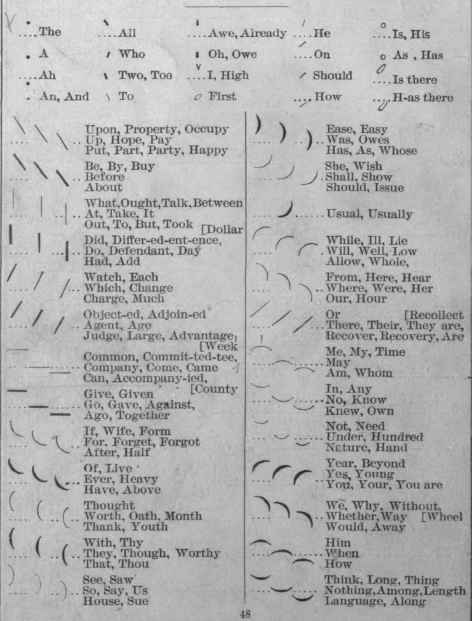
Word-Signs
The ticks for to, how, and should, and the circles for as and has, are used in phrasing only. The word-signs for On, should, and How, are written upward.
Continue to:


My Books

