


Advaita According To The Saiva Siddhanta. Part 4
Description
This section is from the book "Studies In Saiva-Siddhanta", by J. M. Nallasvami Pillai. Also available from Amazon: Studies In Saiva-Siddhanta.
Advaita According To The Saiva Siddhanta. Part 4
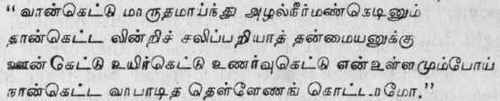
"Though Ether, Wind, Fire, Water, Earth should fail
His Constant Being fails not, knows no weariness!
In Him, my body, soul, and thought and mind were merged (lost),
How all myself was lost, sing we and beat Tellenam."
(from Rev. Doctor G. U. POPE's Translation).
His bodily consciousness, His life-consciousness, His mental consciousness, all these alone constitute his individuality, the feeling of I and mine. This 'I-ness', is what has got to be rid of. So that when this 'I-ness' or individuality is lost,,
 he becomes Sivam or God,
 What perishes of course is the Soul's individuality or consciousness of 'I ness', inducing duality, but what subsists even in Moksha is the soul's personality, which has Svanubhava or Sivanubhava, identifying itself with God.
The soul in union with God becomes pure object (God) as it were, which is the true Monism of Science. Hence it is Saint Meykandan states this paradox (xi. 2. c).: "when-be coming one with God, if the soul perished, there will be nothing to unite with God, as it perishes. If it did not perish, it cannot become one with God. Just like the salt dissolved in water, the soul, after losing its mala, unites itself with His feet and becomes the servant of God (loses its 'I' ness' or individuality). Then it will have no darkness (as separation)." The salt in its crystaline conditions constitutes its individuality. In that condition it is distinguished from water. But after it is dissolved in water, what is lost is its individual character and not itself or its substance or personality.
The following sentence from a text-book of science will show how exact is our language: "When a river enters the sea, it soon loses its individuality, it becomes merged with the body of the ocean, when it loses its current, and when therefore it has no power to keep in suspension the sediment which it had brought down from the higher lands." If re-read as follows, its application will become clear: "When the soul loses its individuality (feeling of 'I' ness, Ahankaram or Anavam), it becomes merged in God, when it loses its Karma, and when therefore it has no power to keep in suspension its mala with which it has been associated from the beginning." And this is the exact figure and language used by St. Meykandan in viii. 4. a. This losing of self is the real sacrifice brought about by love. It is this sacrifice, we are asked to make as we enter the Temple, and the moment we make it, our
 (Pasutvam) will leave us, and we will become the Nandi, the Blissful Sivam.
That the Siddhanta marks the Highest Standard of Monistic Truth is what is brought out by St. Tirumular also in his famous line "Vedanta postulates 'Aham Brahmasmi,' 'I am Brahman,' Siddhanta postulates Tat (one) alone." That is to say that the Siddhanta appeals fully and finally to only One Experience, the Bliss of God and One alone; whereas the Vedanta has reference to the Soham-paths whereby this experience is gained. And anyone can perceive that the Soham experience is a conscious one and a dual one or Dvaita. In this sense Siddhanta is Advaita and Vedanta is Dvaita. And what are considered as the strong-holds of Vedanta by followers of Sankara admit of easy interpretation by the Siddhantis. The question, as pointed out by Sivajnana Yogi, did not arise absolutely as to whether padarthas were one or two. It arose in connection with the famous Mahavakya texts, 'Aham Brahmasmi,' Tatvamasi, etc Says he: -

"If you ask, what then is the meaning of the word Advaitam, I will show how Saiva Siddhantis explain it. On hearing the great texts called Mahavakya, Tatvamasi, etc., which are used in the three persons, we see that these sentences speak of 'that' as one substance and 'Thou' as another, and inquire how one can become the other. The answer is given to remove this doubt, by stating how one can become the other and what relation subsists between these two, and the word Advaitam is used to express this peculiar relation."
The word does not mean one or non-existence of two or more, but is used to express the peculiar relation that exists between two distinct things which can become one, and we had long ago called attention to this meaning in our very first work, and before we had any chance of seeing this luminous exposition of Sivajnana Yogi, and we observed, vide Sivajnana-bodham p. 17:
"Though in all these cases, an identity is perceived, a difference in substance is also felt. It is this relation which could not be easily postulated in words but which may perhaps be conceived, and which is seen as two (Dvaitam) and at the same time as not two (Advaitam); it is this relation which is called' Advaitam, 'a unity in duality,' and the philosophy which postulates it, the Advaita philosophy."
Of all the mass of the Vedic and Theosophic literature that has come into existence during the last two or three decades, there is none that equal the writings of Professor Kunte for real insight into the nature of Hindu philosophy and critical acumen. And his summary, added at the end of the first pada of the first Adhyaya of his translation of the Brahma Sutras, is a most beautiful and original one. Wonderful as it may seem, both Sivajnana Yogi and Kunte exactly propound the same questions and give the same answer. He shows there are texts in the Upanishats which support the dualistic and monistic view, and the mainstay of the monists are the Maha Vakya texts and these texts are the great stumbling block in the path of dualists, and he shows that their interpretation cannot bear an examination, because the texts evidently do not admit of it, and all that they say is simply beside the mark.
Continue to:


My Books

