


Advaita According To The Saiva Siddhanta
Description
This section is from the book "Studies In Saiva-Siddhanta", by J. M. Nallasvami Pillai. Also available from Amazon: Studies In Saiva-Siddhanta.
Advaita According To The Saiva Siddhanta
In a former paper contributed to The New Reformer we dwelt on the Personality of God as understood in the Saiva School; and we propose to dwell at length on the Advaita Philosophy, as expounded by the Siddhanta writers, and we crave the earnest attention of all students of Indian Philosophy; and we confidently hope that as this philosophy is more and more understood, it is bound to win its way into the hearts and hopes of all sincere people of every religion. As we pointed out in our last paper, this philosophy has only been placed before the world at large without being hidden under a bushel, within a short time, and there is all the future before it, when it can shine like a beacon light from the summit of the loftiest hill.
And first we have to point out that the word 'Advaita,' pure and simple, is used to describe their philosophy by all Siddhanta writers; and the word Visishtadvaita never finds place in the Siddhanta Literature. People who for the first time hear of this philosophy put it down at once as Visishta-dvaita, without pausing to enquire into its real aspects. But, as we said above, all Saiva Siddhantis call themselves strict Advaitis. Saint Meykandan uses the word 'Advaita ' in his commentary on the second Sutra of Sivajnanabodham in the passage
 and expounds his system of Advaita. In another place,
 he calls his system.'Advaita,' and addresses his pupils as 'Advaiti.'
Saint Umapati Sivacharya uses it in the following intro-ductory verse in Sivaprakasam: -

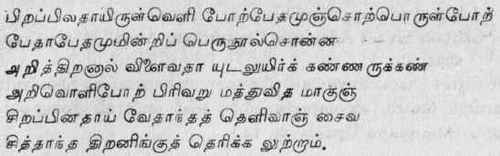
"We expound here the beauty of Saiva Siddhanta, the cream of the Vedanta, whose excellent merit consists in its exposition of the Advaita, postulating an inseparable relation like body and soul, eye and the sun, the soul and the eye, supported as it is by the Dharma of the highest authoritative books, and unlike the Bheda and Bhedabheda and Abheda relations illustrated, respectively, by light and darkness, word and meaning, gold and ornament, set forth by other schools, and which is further supported by perfectly logical methods, and is light to the truth-seekers and darkness to others."
Saint Tayumanavar uses the word freely and has this verse in praise of his Parama Guru Saint Meykandan:

"Oh! for the day when I can reach the feet of my lord, who found the truth of the pure Advaita, and which could not be comprehended by persons dwelling in untruth." There is another verse of his also in which he uses the word twice, illustrating and explaining the meaning of the word itself, and which will be discussed later on:

"Oh! for the day when 1 will be in Advaita relation with God, as1 am now in Advaita relation with Anava (the world)."
Going back to the word itself, it occurs in .the following passages of the Veda and Upanishats, and in. a few other places: -
"Eka eva Rudro Nadvitiyaya tasthe" [Yajur Veda, 1. 8. 6). " Ekhohi Rudro Nadvitiyaya tasthe (Svetas Upanishat, 3, 2-
"Ekamevadvitryam" (Chhandog Upanishat, 6, 2, 1). "Santam Sivam Advaitam Chaturtham Atma" (Mandukya Upanishat, 7). "Amatras chaturtavya vakarika prapunchopasamas Sivodvaitavave." The partless fourth, incomprehensible, that ends ail going out. Siva-advaitam. (Mandukya Upanishat, 12).
The first two texts give the word in its original form, 'Nadvitiyam,' and the word now in use has been got by elision of the initial 'n'; and 'na ' is the negative prefix. The word literally means therefore no two, or not two. The word as used in the texts quoted above and as read with the context would not convey all the philosophic meaning which has been
, imported into it by the Acharyas of various schools. It simply meant there was no other person except the one mentioned at the time. In the first text, it meet an that there was only one
God and no second God. However this be, we have to deal with the word as brought into use by the various schools. And the negative prefix has been taken to mean variously. This prefix is said to connote (1) or Abhava, positive negation, (2)
 Sadrisyam, and (3)
 or virodha - or the opposite. Both in Sanskrit and in English, the same prefix or word is used to denote the first two meanings, but in Tamil we have two different words
 and
and to denote these two different meanings. If in. the word 'Advaitam,' the first meaning be taken, it would mean that one or other of the two or both would be non-existent, and it would mean one only out of the two or neither. Sivajnanasvamigal points out that almost all the Acharyas of other schools, including Sankara, Ramanuja and Madhva take it to mean 'one,' taking the 'Abhava' meaning. If the Sadrisya meaning be taken, it would mean non-different or non-dual. This meaning is best explained and illustrated by taking the first stanza of chapter 36 of the sacred Kural - entitled "How to Perceive Truth.'
Continue to:


My Books

