


An Another Side. Part 2
Description
This section is from the book "Studies In Saiva-Siddhanta", by J. M. Nallasvami Pillai. Also available from Amazon: Studies In Saiva-Siddhanta.
An Another Side. Part 2
It covers a greater sphere, and all the spheres covered by its own productions, the senses. But take the intellect (Buddhi) itself in its relation to the Soul. The Soul is sentient and Buddhi is insentient. The latter is nowhere, when the Soul is in itself. As such, the Soul is more really omnipresent than Pradhana or Nature. That is to say, there are different planes of existence, and different grades of Vyapaka Vyapya. The one lowest is Vyapya, and the one higher is Vyapaka, and this higher itself is Vyapya when compared with something higher than itself, and so on, till we arrive at a Being, Who is most omnipresent and beyond Whom our thought and mind cannot penetrate. This view of the Sankhyan has no doubt not presented itself to the Vedantin, and what the latter has however in his mind is the old riddle, how can two things co-exist, and one be omnipresent? Like all such riddles, this is based on a fallacy, in not taking note of the facts above presented, about the essential difference between Pradhana and the Soul. The riddle supposes that two things are of the same kind, of the same quantity, length, breadth, width and of the same density or tenuity etc. If they are so, no doubt it will be an impossibility.
But we contend that things of different densities and tenuities can fill and overlap one over the other, and much more so when one is sentient and Chit, and the other is non-sentient and Achit. For instance, there can be no two things so contrary in Nature as Light and Darkness. And do they co-exist or not, or are they one and the same ? To the objection of the Vedantin, that darkness is no padartha, we have only to instance the recent discoveries of our own Hindu Scientist, I mean Dr. Bose, who could demonstrate the presence of invisible rays of light in a pitch-dark room by means of his instrument. What does this mean? The ray of light has been so thin as to be swallowed up in the grosser darkness. When a lamp is brought, it could dispel the darkness itself; but, only within a certain radius. Then a bigger light, a gaslight, an electric light of a vast number of candle powers ; but all these pale away before the brilliant light of the Sun. There is, thus, such a merger of one,,the less powerful, in one more tenuous: are not all these summed up in the simple sentence "Nachichchitsannidhau ", 'In the presence of the Sat, every thing else is sunyam (non-existent - non-apparent'?
Saint Meykanda Deva adds 'As before the Perfect and Eternal Intelligence, the imperfect and acquired intelligence (falsehood) is shorn of its light, it is therefore established that in the presence of the Sat, Asat loses its light." And the illustration implied in this, is amplified in the following verse, "Evil (Asat) ceases to exist before Him, as does darkness before the Sun." The term Asat has itself been the parent of many misconceptions, in the East and in the West, and different interpreters of Sankara explain it in different ways. Here is what a critic of Paul Deussen says, "Kant is mostly credited with having proved that there is something behind or beneath the "reality" of our senses, which these cannot fathom. 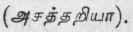 The European scientists say sneeringly: What of that; if we cannot get at it, let us ignore it! And on the other hand, the Neo-Kantian Metaphysicians say: No, this is the only reality; therefore, all the rest is useless rubbish, only fit for momentary amusement: and that is all.
"That is the Western conception of the Indian term Maya (Asat), indeed a rubbish conception. And mistaken by this illusion, Western philosophers have declared that Eastern philosophy and particularly Vedantism and Buddhism, are Akosmism' i.e., they deny the existence of the universe altogether. An incredible absurdity! Is not the real meaning of Sankara easy enough to understand? Every one knows that there are different states of consciousness; that of an animal is different from that of a man, that of a savage different from that of a savant, that of a waking man different from that of a dreaming man, and all these are different from that of a sage in Samadhi. Now, it is a matter of course, that the 'reality' of a waking man is different from that 'reality' which he conceives as such when he is dreaming, and both are very different from that 'realit' or those different states of 'reality' of which he becomes conscious when he enters Sushupti and Turiya, and all these are, again, other 'realities' than that as which the Mukta 'realizes' Atman. Viewed from the standpoint of any of these different states of consciousness, all the other conceptions of 'reality' appear as Maya, as illusion or as unreal.
The material scientist, together with most European philosophers, would even not hesitate a minute to declare the alleged realisation of Atman an illusion, although he would not deny that this might be some state of consciousness."
And, by the way, he objects to translating Avidya as ignorance or nescience, but as not-Vidya or not-yet-wise or other-than-wise. That is, Asat does not mean non-existent, but not-Sat or other-than-Sat. This is Sankara's view according to Dr. Hubbe Schleiden; and this is the view we have taken trouble to expound above, and yet how many followers of Sankara hesitate before reading Maya as illusion and delusion, and Avidya as ignorance and nescience. In the very article under review, we read in one sentence that each soul is a spark, a part; in the next sentence, no, it is not a part, but the whole of Brahman. In the very next sentence, all these souls are but reflexions of Brahman, and are not real. "Men, women and animals etc, are but reflexions of Him, and are unreal in themselves." If they are mere reflexions, and unreal, how is it reconcilable with the statement, that each soul is not even apart but the whole of Brahman. The whole argument is made up by the use of similes and by not sticking to one, but by jumping from one into another, to meet the difficulty arising in the former.
Continue to:


My Books

