


Ashtamuhurtam. Part 2
Description
This section is from the book "Studies In Saiva-Siddhanta", by J. M. Nallasvami Pillai. Also available from Amazon: Studies In Saiva-Siddhanta.
Ashtamuhurtam. Part 2
"Spectator, and Permitter, Supporter, Enjoyer, Mahesvara, thus is styled Paramatmau ; In this body Parama Purusha"
We have elsewhere observed how the sole purpose of the Puranas and Itihasas is merely to explain the particular text of the Veda or Upanishat. The passage in the Upa Brahmana embodies the particular text and explains it.
See how this passage, from Parasara Purana reproduces the words and meaning of the Rich text quoted above.
"Antarichchandiya Rudram Sadha Vantayam Manishya Kruhnanti Sihvaya tahirasa purno Amritodakam Antar Nachchantiya Rudram Bahvanu Sahitam Sivam Purusha Mavagrihnanti Sikvayatanasamsayah."
The following passage from Skanda Purana also says that the Jiva is the body of god.
"Antaryami Sa Avisha Jivanam Paramesvarah"
"That same Paramesvara is the Antaryami in all jivas".
Turning to Mahabharata, the statement that God has these eight objects for His body and that the universe is His Form, that He is different from the universe occurs very frequently.
We cite the following passages from the Anusasana Parva, P. C. Roy's edition: -
"Him that hath universe for His form " page. 49
"Thou art of the form of all jivas in the universe" page. 125.
"Thou art the Lord of Jivas" page 133. "Thou hast universe for thy form " page 105.
"Thou art He who has the whole universe for His limbs" page 104.
"He pervades all things in the universe and yet is not seen anywhere" page 50.
"Agitating both Prakriti and Purusha by means of his energy (Sakti), He created therefrom the universal lord of creatures, Brahma."
"He is both Sat and Asat."
>
"He transcends both Prakriti and Purusha" page 50. "Thou art He called Sat of Sat" page 127.
"Having created all the worlds beginning with "Bhu" together with all the denizens of heavens, Thou upholdest and cherishest them all, distributing Thyself into the well-known forms numbering eight" page 96.
The poet Kalidasa in his benedictory verse in Sakuntala explains what these eight forms are,
Isa preserve you! He who is revealed
In these eight forms by man perceptible -
Water, of all creation's works the first;
The Fire that bears on high the sacrifice
Presented with solemnity to heaven;
The Priest, the holy offerer of gifts;
The Sun and Moon, those two majestic orbs,
Eternal marshallers of day and night;
The subtle Ether, vehicle of sound,
Diffused throughout the boundless universe,
The Earth, by sages called, 'The place of birth
Of all material essences and things,'
And Air, which giveth life to all that breathe.
There is also this verse, for which we cannot find any reference, which gives eight names of God as He dwells in His eight forms.
"Prithivyo Bava, Apach Sarvah, Agne Rudrah, Vayur Bhimah, Akasasya Mahadevah, Suryas Yograh, Chandrasya Somah, Atmanah Pasupatih"
Note here that the word Hotri meaning the sacrificer or the Yajaman (master) of the sacrifice, stands for atma, Jiva or Pasu. Hence the Lord of the pasu is called Pasupati. (Meda Pati)
We quote a few more passages from Mahabharata.
"Thou art the eight Prakritis; Thou art again above the eight Prakritis, everything that exists represents a portion of Thy divine Self", page 99.
The following passage explains why God should multiply Himself, why He should manifest Himself into these eight forms; i. e., why God should bring about the evolution and creation of this world; not of course, from any moral necessity connected with the doctrine of samsara; not of course, from His Will to exist and desire for enjoyment; not of course, from a desire to see His own reflexion; not, of course, from a necessity to seek His own salvation; but that this evolution is necessitated for the improvement and salvation of the sin-covered soul.
"Know O Kesava, that this all, consisting of animate and inanimate existences, with heaven and other unseen entities, which occurs in these worlds, and which has the All-pervading Lord for its soul, has flowed from Mahesvara, and has been created by Him for the enjoyment of Jiva." page 70.
The soul, in its Kevala condition, lies in utter and hopeless oblivion, and helplessness. The Lord Wills (Ichcha sakti) that these souls should reach salvation out of His pure Grace (Arul Sakti); and by means of His own Energy (Kriya sakti) He agitates and puts motion and life into Prakriti (Maya Sakti); and Purusha (souls) and the whole of the manifested universe is brought forth from His womb. The souls in these material bodies act, and gain experience and knowledge, and finally effect freedom from the bondage of birth and death. Thus, the soul passes through its sakala and athitha conditions; and it is the fundamental tenet of every school of Hindu philosophers that unless the soul enters the cycle of samsara, that wheel of birth and death, the soul cannot reach Mukti.
We close this paper with a few quotations from the Dravida Sruti bearing on the question under discussion. Our saint Tirumular says.
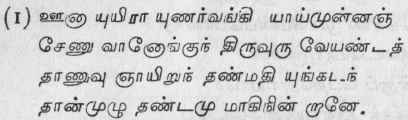
The body and soul, and fire and far spreading Air and space, and earth, His form, The fixed sun, cool moon, transcending these, Yet stands He as the stupendous world.
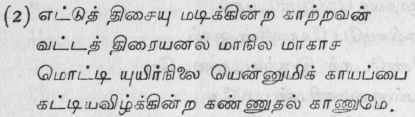
The wind that blows in eight quarters is He. The whirling flood and fire, huge earth and space, The sentient soul with these His bodily'frame, He joins, and leaves, the God with the frontal Eye.
From our Sainted Lady of Karaikal, we have the following verse.
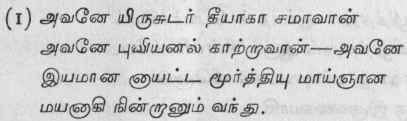
Two Lights, the fire and space is He The earth and water, air is He The soul, with these His eight forms He stands as Intelligence pure.
Continue to:


My Books

