


The House Of God. "Ye Are The Temples Of God.". Continued
Description
This section is from the book "Studies In Saiva-Siddhanta", by J. M. Nallasvami Pillai. Also available from Amazon: Studies In Saiva-Siddhanta.
The House Of God. "Ye Are The Temples Of God.". Continued
And is not the present enquiry solely devoted to reach 'the region of universalism,' where, in the words of our Sage every religionist comes and bows in adoration of the One Supreme, saying they see no symbols of any creed but all Akas? And he states in the previous lines that he reached this region, after looking in vain in every creed and in every path for that Pure Spirit which seeks to reconcile with the path of noblest knowledge, all the bitter conflicting creeds and religions.
Tayumanavar.

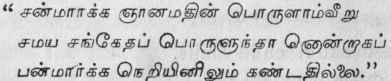
And the place is worth a trial visit even to-day, for does not Tayumanavar record his experience, that his stony heart melted into love and bliss, the moment he saw the Holy Presence?

This has not been his experience only, of believers alone. Ages back, scoffers and atheists have felt the power of this Presence, and it is recorded of the great Atheist Guru, Jaimini, that when he approached, all his unbelief left him, and he composed his song of Vedapadastava. And though there are thousands of temples all over the land, the heart of every true believer has always turned, with love and longing, to this centre-spot. And it is believed that Chidambaram occupies a central geographical position between the northern and southern extremes of India, including Ceylon. And corresponding to this position in the macrocosm, Arumukha Navalar observes that, in the human microcosm also, the place points to the region of Sushumna between Ida and Pingala nadis. There is another centre of heat and vitality and light in the human body, and that is the heart. And the heart is the most vital and delicate organ in the whole system. Every other organ requires its help for its nourishment and upkeep. It is saved and protected from many an ill, by its position, which every other organ is exposed to; but that is because that, whereas life can be prolonged even after injury to every other organ, life ebbs away the instant the heart is injured.
And then, is not the heart, the seat of love, love pure and undefiled? Pity, kindness, mercy, grace, are all different shades of this one Love,  Bhakti, faith. Is there anything else that can compete with this Supreme Principle? Knowledge, you may exclaim, with its seat in the brain. We dare say, 'not.' The slightest injury to the heart completely paralyses the brain. And the pulsation in the brain itself rises and falls with the beat of the heart itself. It is the one organ in the body which is ever active, and knows no rest, when everything else, including the brain, undergoes rest. And in human nature also, what is there which love cannot quicken? It can give life to the despairing and the lifeless, strength to the weak, courage to the coward; and instances have not been wanting to show what extraordinary feats of intellect, love has been the cause of. The whole world is bound by the heart, much more than by the intellect alone. And Mrs. Humphrey Ward has portrayed in glowing words the difference between the man of the intellect and the man of the heart in her Robert Elsemere. There, the man of the intellect pines, in secret and in his pride, for that very touch which makes the whole world kin. And it is in this heart, all mankind have liked to build a temple for the Most High. And the only requisite is, that this heart be pure.
And the moment this heart is pure, there the light from the Invisible Akas will shine, dispelling the darkness that blinds the eye, and enabling it to see.

"Blessed are the pure in heart, for they shall see God." said the Lord Jesus. And the sage who composed the Taittiriya Upanishat sang long before him: "Satyam jnanam anantam Brahma, Yo veda nihitam guhayam Paramevyoman, So'snute sarvan kamantsaha, Brahmana vipaschiteti ".
"He who knows Brahman, which is Sat, which is Chit, and which is endless (Bliss), as hidden in the cave (of the heart) in the highest Akas, he enjoys all blessings as one with the Omniscient Brahman." And the most mystical and oldest of the Upanishats, the Chhandogya, also repeats the same instruction. "Would you like to know what that one, thing is, which you have to search for and to know? And when you have to search for it, how to know it? Hear! There is the Brahmapura (body), and, in it, the Dahara (palace) of the lotus (Pundarika) of the heart, and, in it, that Antar-Akasa. Now, what exists id this Akasa. That is to be sought after, That is to be understood.
"As large as this Akasa is, so large is that Akasa within the heart. Both heaven and earth are contained in it; both
Fire and Air; both Sun and Moon; both Lightning and Stars; and whatever there is of Him in this world, and whatever is not, all that, is contained within it." (VIII, I. 123) In an earlier chapter, this Supreme Being is called "The Intelligent, Whose body is Prana, Whose form is Light (jyotis), Whose thoughts are true, Who is like the Akasa (omnipresent and invisible), from Whom all works, all desires, all sweet odours, and tastes, proceed; the Atma within the heart, smaller than a grain of rice, smaller than a grain of barley, smaller than a mustard-seed, smaller than a canary-seed, or the kernel of a canary-seed; also the Atma within the heart, greater than the Earth, greater than the Sky, greater than the Heaven, greater than all these Worlds." (III. 14. 223). In a later passage, the Upanishat says that "He who is called Akasa is the revealer of all forms and names; That within which these forms and names are contained, is the Brahman, the Immortal, the Atma." (VIII. 13. 1). The following verse occurs in the Katha (L 2. 20)., the Svetasvatara (III. 20). and the Taittiriya-mahopanishat, and the same is reproduced in the Sivamahapurana.
"Smaller than small, yet greater than great, in the heart (Guha) of this creature, Atma or Isa doth repose: That, free from desire, He sees, with His grief gone, the Lord and His might, by His favour." In the Kaivalyopanishat, the same is reproduced, in the following words: "Beyond the heavens, yet shining in the heart (Guha) of his creatures, Him the sages, free from desire, reach." Sri Krishna also imparts this most secret of secrets to his pupil, "that Isvara dwelleth in the hearts of all beings, O Arjuna, by his maya, causing all beings to revolve, as though mounted on a potter's wheel," and importunes him to flee to Him to secure Supreme Peace by His Grace. The manner of occupying this seat or dwelling place is elsewhere referred to, in the XIIIth and IXth discourses, 32nd and 6th verses respectively, and these three or four verses bring out the whole of the Upanishat thoughts. "As the Omnipresent Akasa is not soiled, by reason of its subtlety, so, seated everywhere in the body, the Self is not soiled," "The support of beings, and not rooted in beings, my Atma is their efficient cause; as rooted in the Akasa, the mighty air moves everywhere, so, all things rest, rooted in me." This Supporter, Permitter, Spectator and Enjoyer, is styled Mahesvara, Paramatman and Parama-Purusha, in verse 22, chapter XIII. Another verse in the Chhan-dogya says that Gayatri is the body and the heart, because in it all the spirits are established.
No wonder, therefore, that in almost every page of the Tamil Veda, and the writings of the later Tamil Saints, God's truest dwelling place, His house, His palace, His seat, is universally referred to as the human heart.  And so it is that the famous Shrine we are speaking of, is, by preeminence called
 "The beautiful House," inasmuch as it is also called the "Pundarika Vidu"
 "the House of lotus", or "Dahara Vidu" also. And, to-day, we will stop, after identifying this Golden Palace in Chidambaram with the "Human Heart" spoken of in the most ancient writings, and we will speak of the Great King and Lord, Who is the Dweller in this Palace and His characteristics, in a future issue.
[* It is interesting to note that the chief Temple in Mecca is called al Caaba,' literally meaning, ' The House' and the Hebrew word for the great Temple at Jerusalem also meant simply,'The House,' "The House of God."]
Lotus Of The Heart
If the real nature of the Lotus of the Heart is examined, its stalk will be the 24 tattvas, beginning with earth; its petals, vidya-tattvas and suddha-vidya; its pollen, the 64 kalas of Isvara and Sadasiva; its ovary, Sakti, the essence of kalas; its seeds, the 51 forms of nadam; and the arul-sakti of the Lord Siva rests on it (as fragrance).
(Sivajnanabodham IX. 3. c)
Continue to:


My Books

