


The Nature Of The Jiva. Part 6
Description
This section is from the book "Studies In Saiva-Siddhanta", by J. M. Nallasvami Pillai. Also available from Amazon: Studies In Saiva-Siddhanta.
The Nature Of The Jiva. Part 6
But you will not be able to find it in darkness; it will be utterly lost. This brilliance is not its own, and it is derived from the sun-light or the lamp-light. This is the difference between man and God. We are the crystals and He is the light reflected in the crystal. How well is this brought out by St. Appar in his phrase "O thou light imbedded in the white crystal! "How well does Tennyson grasp the situation when he says "we are but broken lights of thee!" Nay, not exactly so. "We are only shining from borrowed light from thee." Whatever good is in man is all derived from God's light. In our Kevala condition, we are like the diamond buried in dirt and darkness. When brought to light, it is still covered by dirt and the more and more we cleanse it by turning it on the diamond cutter's lathe, the more and more we let light into it. This is our Sakala condition, where we are able to exercise our will and intelligence with the grace of the Lord. When the whole diamond is polished and rounded, the full blaze of light will shine on it, and the diamond will be lost in the brilliance. This is the Suddha or Moksha condition. Bhanda results when this dirt covers it, and Moksha, when the dirt is removed. Nay, the latter condition is not the mere removal of dirt alone. There is the flooding of light - Anubhuti, Sivanubhuti or Svanubhogam. Would anybody appreciate a polished diamond if it will not reflect the light.
See how well St. Arunagiri puts it:
* As you drive about in the road between II and 12 forenoon, if you look at one of the Municipal lanterns, you will realize this.
† The facets of the cut-diamond act as a prism and so refract the different colours of the sun's rays. Crystal water has the same power and 1. have seen the water refracting the different colours in the famous spring at the Mahanandi (Nandiyal, in Kurnool District)..
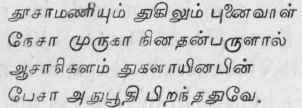
"O! Thou lover of the well adorned Devasena, O Muruga! with Thy kindly grace, The chains of desire are sundered in twain, And Io ! that unspeakable joy was born."
And consider the divine words of St. Tiruraular.
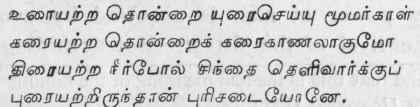
"O Ye fools ! who speak of the unspeakable, Can ye find the limits of the limitless one? When as waveless sea, ye attain clearness of mind, Then will the Lord with braided hair appear bright."
Why do we desire the purity of the crystal and the clearness of water? Why do we love all that is loveable in nature? Why do we love one another? Why does a husband love his wife, a father his children, and so on? Is it because of these things themselves that we love them and ought to love them? When we do, our bhandam is assured; we begin to gather precious stones, lovely objects and beautiful women all round us and strive hard to gather more and more. But when we recognize that it is not for these that we love them but for the Lord imbedded in them who gives them their life and light and love, then will our thoughts be turned away from them, be fixed in the Light Adorable, and our Moksha will be realized.* It has also to ,be noted how this attachment of dirt to the crystal or the man is not one that goes to its core. If so, this dirt or defect could never be removed. It is not that man is by nature unintelligent and impure, and he grows more intelligent and better by education and evolution. But all the purity, and perfection, all his powers are in him to the full: only they are veiled and covered by dirt, and once the veil is removed, he regains himself and sees his true form (Atma Darsan) just for a moment when he feels in his Vibhutitvam (expanded nature) he is all that, and then merges himself in the Feet of the Lord. This distinction is important, as this marks the fundamental difference between Indian Philosophy and Western philosophy. This is why the Western philosophy of Evolution has been found to fail. The superstructure is all right but the foundation is all wrong. According to the theory of evolution, everything, every power of man is acquired by evolution, adaptation and survival of the fittest.
But according to us,
* Few understand that this is the real meaning of the famous passage in the Brihadaranyaka Upanishat II (iv. 5),
"Verily, a husband is not dear that you may love the husband ; but that you may love God. the husband is dear.
"Verily, a wife is not dear that you may love the wife; but that you may love God, therefore a wife is dear.
"Verily, sons are not dear, that you may love the sons; but that you may love God, therefore sons are dear.
"Verily, wealth is not dear that you may love wealth; but that you may love God, therefore wealth is dear." everything is there - all his powers of Ichcha, Kriya and Jnana. He is also Satchidanarjda, but the powers are veiled and all the Panchakritya and evolutionary powers are required to rid him of his veils. And when this veil is removed, his original form is attained.* Here again another caution is required to be borne in mind.
The soul no doubt regains its full powers of Ichcha, Kriya and Jnana and becomes Satchidananda. But these have to be distinguished from those of the Supreme. And here it is where the Upanishat and other writings speak of the Freed soul and its greatness, the passages there are misunderstood, and identity of soul with God is sought to be made out. No doubt the identity of God and soul has been reached, and no doubt what is perceived in the freed soul is not the soul itself but the full Light of the Lord and the soul itself becomes merged in the overpowering Sivanubhoga, on account of the characteristic of the soul we have all along been considering. There is joy inseparable to the soul no doubt, but it is not conscious of such joy. It sees then without seeing; it hears then without hearing; it smells there without smelling; it tastes there without tasting: it thinks there without thinking. Once its consciousness enters into its feeling, there will be duality, and the Bliss will be lost: †
Continue to:


My Books

