


Archery For Inn. Part 3
Description
This section is from the book "Time Out for Living", by Ernest DeAlton Partridge and Catherine Mooney. Also available from Amazon: Time Out for Living.
Archery For Inn. Part 3
There were lighter moments, too, such as the Novelty Shoot for the juniors. These young archers aimed at balloons, filled with lighter-than-air gas, fluttering in the breeze. Before the day was over both Tony and Maris were eager to try their hands at shooting. Alyce and Harrison did not win the tournament, but they did well, considering how new they were at the sport. As Alyce pointed out later in the day, the purpose of the tournament was not necessarily to win. Shooting with others offered fun and a chance to learn.
That evening as the four of them sat about a fire in Alyce's house chatting about their various experiences that day, both Tony and Maris loudly proclaimed that they were eager to get started in this new sport. Alyce and Harrison promised to help them select their equipment and teach them how to shoot. Tony was a little confused with all the new words he had learned. Rounds, ends, range stick, and many others were buzzing through his head. Harrison gave him several copies of an archery magazine to look over at his leisure. From these publications he learned even more about archery.
For example, he did not know that flight shooting meant shooting an arrow the greatest possible distance. Records for flight are continually being broken. The present record is 758 yards, 1 foot for free style, and 481 yards for regular style. Seven hundred and fifty-eight yards is more than three times as far as Babe Ruth's longest home run. It is farther than the ordinary revolver bullet will carry, and twice as far as great golfers can drive a golf ball, very nearly a half mile.
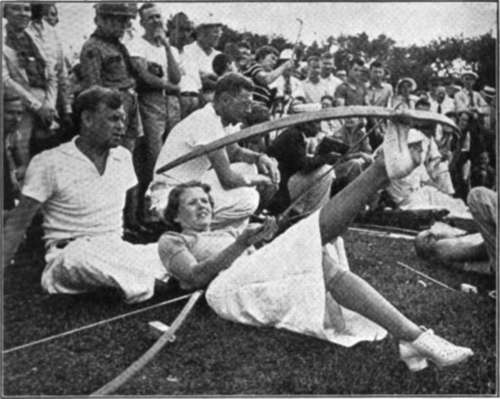
Free-style flight shooting.
In regular flight shooting, the man may use only one hand to draw the string and he must be in a standing position similar to that described in clout shooting. In free-style flight shooting, the archer may assume any position but the regular one. He generally lies on his back, with a bow strapped on his feet, so that he may use both hands in pulling back the string.
Flight shooting requires not only an entirely different method of shooting but also different equipment. A much heavier bow is used, one that may need an eighty-pound pull or more to draw it back, and much lighter and thinner arrows with celluloid vanes in the place of the regular feathers. A separate championship is usually offered for flight shooting at the large tournaments.
Tony learned, too, about archery golf. You can probably guess what the nature of this form of archery is from the name. The game is played with golf rules and with a bow and arrow rather than with a stick and ball. It is played, usually, on a regular golf course with some type of small target instead of a cup. On some of the more popular golf courses, permanent archery golf targets have been set up.

A Group Playing Archery Golf.
Archery golf attracts persons of all ages and degrees of skill at archery. It allows for more sociability than regular target shooting and is less exacting.
The archer may use as many arrows as he wishes, but only one bow. Usually he carries two or three arrows, a flight arrow for the longer shots, an approach arrow, and a target arrow for putting. As you probably know, the score in golf consists of the number of strokes it takes to drive the ball around the course, which usually consists of eighteen holes. Par on a golf course refers to the number of strokes it takes an unusually good player to go around the course. The par for archery golf, interestingly enough, is generally nine under the regular golf par. A good archery golfer will finish nine holes with a score of thirty or thirty-two.
Then Tony read about the Pope-Young Round, which sounded especially interesting. Saxton Pope and Art Young were famous big-game hunters with the bow and arrow. They were very skillful in shooting at unknown distances. That is, they could shoot accurately without knowing how many yards lay between them and their target. Among other animals, they killed African lions, moose, and Kadiak bears. Because archers throughout America admired their great skill, the Pope-Young Round was established after Young's death in February, 1935. The round has been adopted by the National Archery Association, and each year archers compete for a trophy at the National Tournament. This novelty round offers relaxation for any tournament or club crowd after the strain of target competition. In brief, the round consists of thirty-six arrows shot at unknown distances between thirty and eighty yards. The time limit for shooting each end of six arrows is forty-five seconds.
Similar to both archery golf and the Pope-Young Round is archery roving, in which the archer shoots at various objects, such as cardboard animals laid out at varying distances in a field and under different handicaps.
Harrison had told Tony that he would not understand a Novelty Tournament unless he saw one. Nevertheless, Tony looked it up in the books he could find and discovered that there arc many kinds of Novelty Shoots that can be planned for club and school groups. There is the familiar Elimination Tournament, in which the contestants shoot it out in pairs until the final winners end the tournament by shooting in the last contest. Another type is the Ladder Tournament, for which the names of those who wish to enter are listed one above the other like a ladder. Each person then challenges the one above him on the ladder, and if he wins moves up one place. The one on top of the ladder stays there as long as no one outshoots him.
Continue to:


My Books

