


Batzen. Part 13
Description
This section is from the "Encyclopedia Of Practical Receipts And Processes" book, by William B. Dick. Also available from Amazon: Dick's encyclopedia of practical receipts and processes.
Batzen. Part 13
6154. To Reduce a Liquid to a Given Density
6154. To Reduce a Liquid to a Given Density. It has been already stated in No. 52 that the actual weight of any substance may be found by weighing an exactly equal bulk of water, and multiplying the weight found by the specific gravity of the substance; the product is the actual weight. To simplify this, suppose that a liquid has a specific gravity of 1.325; also that a certain bulk of water (say any 1 measure) weighs 100 grains; then a similar bulk (1 measure) of the substance would weigh 100X 1.325 = 132.5 grains. Now, supposing we wish to reduce the weight of this liquid, so that 1 measure of it shall weigh only 115.5 grains (that is, shall have a specific gravity of 1.155), how much water, whose specific gravity is 1.000, must be added to it to produce this result ?
From the nature of the proposition, it follows that the bulk of the substance (1) multiplied by its specific gravity (1.325), added to the bulk of added (unknown) water multiplied by its specific gravity (1.000), must be equal to the aggregate bulk of the substance and of the water combined, multiplied by its required specific gravity (1.155).
Putting the above words into shape, and assuming x to be the required bulk or quantity of water
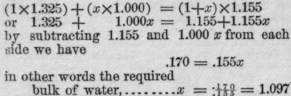
If, as supposed above, the measure assumed was such that it weighed 100 grains of water, we should have to add 109 7/10 grains of water to 1 measure of the substance to produce a mixture of specific gravity 1.155.
6155. Gay Lussac's Light Areometer Reduced to Specific Gravity
6155. Gay Lussac's Light Areometer Reduced to Specific Gravity. This instrument ranges from 0° to 50°, 0° corresponding with water at 59° Fahr.
Degree. | Sp. Gr. | Diff. | Degree. | Sp. Gr. | Diff. |
0° | 1.0000 | .0095 | 30° | .7692 | .0057 |
5 | .9524 | .0087 | 35 | .7407 | .0053 |
10 | .9090 | .0079 | 40 | .7143 | .0049 |
15 | .8696 | .0073 | 45 | .6897 | .0044 |
20 | .8333 | .0067 | 50 | .6667 | |
25 | .8000 | .0062 |
This table gives the specific gravity corresponding to every 5 degrees of the scale. To find the specific gravity of intermediate degrees, the average difference between each degree is given in the third column, each given difference referring to the four degrees following the degree opposite which the difference is placed. Thus: To find the specific gravity corresponding with 33 degrees of the scale, look in the table for the specific gravity of the nearest lower degree given, in this instance 30°; and we find .7692; 33° is 3° more than 30°, hence we must deduct 3 times the given difference (.0057), or .0171; this last deducted from .7692 = .7521, which is the approximate specific gravity corresponding to 33° of the scale.
The intermediate degrees of other areometers may be determined in a similar manner.
The corresponding degrees of different areometers may also be found by a comparison with their respective specific gravities; allowance being made for difference of temperature.
Information showing the practical use of some of the areometers will be found in Nos. 58 to 68.
Continue to:


My Books

