


The Art of Soap-Making. Part 6
Description
This section is from the "Encyclopedia Of Practical Receipts And Processes" book, by William B. Dick. Also available from Amazon: Dick's encyclopedia of practical receipts and processes.
The Art of Soap-Making. Part 6
546. Chemical Soap
546. Chemical Soap. Powdered fuller's earth, 1 ounce; just moisten with spirits of turpentine; add salt of tartar, 1 ounce; best potash, 1 ounce; work the whole into a paste with a little soap. It is excellent for removing grease spots.
547. To Make Hard White Tallow Soap
547. To Make Hard White Tallow Soap. Dissolve 2 pounds sal soda in 1 gallon boiling soft water; mix into it 2 pounds fresh slacked lime, stirring occasionally for a few hours; then let it settle, pour off the clear liquid, and boil 2 pounds tallow in it until all the tallow is dissolved. Cool it in a flat box, and cut it into bars or cakes. It can be scented by stirring in the desired perfume when cool.
548. To Make Home-made Caustic Soda
548. To Make Home-made Caustic Soda. Dissolve 6 pounds common washing soda in 4 gallons warm water; slack 6 pounds clean fresh quicklime in a tub, using only as much water as is needed to crumble it perfectly ; add the slacked lime to the solution of soda; stir the two together, adding 4 gallons boiling water; stir thoroughly and let it settle; then pour off the clear lye for use.
549. To Make Domestic Soap
549. To Make Domestic Soap. Put the caustic soda lye, prepared in the manner and quantity given in the last receipt, into a clean iron kettle, and add, during continual stirring, 12 pounds clarified grease, dusting in, a little at a time, 4 ounces finely powdered borax; let it boil gently for 10 or 15 minutes, until it thickens and becomes ropy; then have in readiness a tight box, lined with a piece of muslin large enough to hang well over the sides, to allow of the contents being afterward conveniently lifted out; pour the mixture from the kettle into the box, and let it stand for a few days to harden; when sufficiently firm, turn it out onto a table, and cut it into bars with a thin wire. Soap thus made, and left to harden in a dry room, will be fit for use in a month.
550. To Make Home-made Caustic Lye from Ashes
550. To Make Home-made Caustic Lye from Ashes. Provide a box whose sides terminate in a point, and having an orifice at the lower end (see illustration); this should be mounted high enough to allow of a vessel being placed underneath it, to receive the liquid that runs out of the bottom. The box is then well lined with straw (see No. 607 (Fine Shaving Cream)), upon which fresh wood ashes are placed, adding to the ashes about one twen-
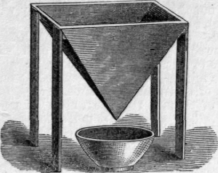
tieth the quantity of fresh slacked lime (see No. 519 (To Make Soap-makers' Lye)); then pour hot water upon it, and the lye will filter through into the vessel below. For the purposes of soap-making, this lye must be concentrated by boiling until a sound potato will not sink below the surface.
Continue to:


My Books

