


Lake Como. Part 14
Description
This section is from the book "Lake Como - John L. Stoddard's Lectures", by John L. Stoddard. Also available from Amazon: John L. Stoddard's Lectures 13 Volume Set.
Lake Como. Part 14

Head Of Venus, By Canova. Villa Carlotta.
Beyond the northern limit of the Tremezzina, a series of hotels and villas line the water's edge for several miles in sections known as Tre-mezzo, Cadenabbia, and Menaggio. Here, in the "season," gather hundreds of enthusiastic English, German, and American tourists, who, not unlike a flock of migratory birds of brilliant plumage, make a brief sojourn by the lake, ere they resume their flight, in autumn, for the south of Italy, Egypt, and the Riviera; or, in the spring, for England, Germany, and France. The road uniting all these points must rank as one of the finest walks in Europe. Particularly charming is that part of it which links Tre-mezzo with its still more beautiful companion, Ca-denabbia. It even bears the fascinating name of Via del Paradise No one whose feet have ever trodden it can possibly forget how, at the end of a delightful day, Across the water's purple bloom Bell aggio, bathed in sunset light. Surmounts the twilight's gathering gloom With glistening walls of pink and white, -The wraith of some celestial strand, The fringe of an enchanted land.

A Silent Path.

Tremezzo.
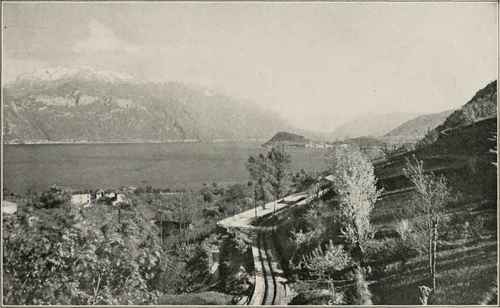
The Western Shore, Above Menaggio.
Meantime, upon the other side of this Path of Paradise, in fact so near it that the air is permeated with their fragrance, rise the terraced gardens of the Villa Carlotta, which art and nature have combined to render one of the chief attractions of North Italy. The history of this estate follows the not infrequent course of transfer from Italian to Teutonic hands. Built by the Marquis Clerici about the middle of the eighteenth century, it became in 1802 the property of the Sommariva family, and for some forty years was called by that mellifluous name. As such, the title was made rhythmical by Longfellow in his well-known lines:

Distant View Of Bellaggio.

The Via Del Paradiso.
"By Sommariva's garden gate I make the marble stairs my seat, And hear the water, as I wait, Lapping the steps beneath my feet".
In 1843, however, a Prussian princess bought the place, and gave it to her daughter, Carlotta, wife of the Grand Duke of Saxe-Meiningen, who, on her death in 1855, became its owner. It is perhaps worth noting here, in passing, how many castles, villas, and desirable properties in Austria, Italy, and the Riviera are steadily passing into German hands. Even the Grecian island of Corfu can now claim the German kaiser as a property owner, since he has bought there the magnificent estate of Achilleion, the former residence of the Austrian empress Elizabeth. Opinions differ as to whether this mild sort of German colonization would exert much influence in the event of those political disturbances, which are so little talked of, yet so greatly dreaded. It is, however, impossible to ignore the fact that Germany is growing more and more prosperous and powerful, and that its rapidly increasing population is now expanding in all directions, acquiring property in foreign lands, and traveling everywhere in numbers which a score of years ago would have appeared incredible. Whether one likes the prospect or dislikes it, all indications point to the fact that in the coming century Germany is to be the dominant European power.
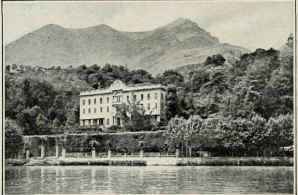
The Villa Carlotta.
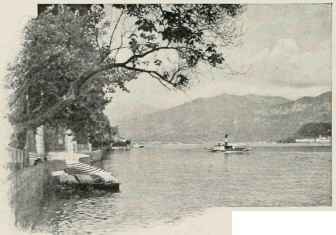
Steps Of The Villa.
England and France seem destined slowly to decline; while Germany, when it shall have welcomed Austria as a member of the empire, will cut a broad swath straight through central Europe from the Baltic to the Adriatic, making Trieste in the south what Hamburg is in the north. Moreover, when it shall have acquired Holland, together with her colonies of Java and Sumatra, it will proceed to verify emphatically the kaiser's words: "Germany's future lies upon the water." Will there be war, resistance, and tremendous national combinations to oppose all this? Assuredly. Vet to the writer, after six years' residence in Austria and two in Italy, the future of the German race, within the mold thus roughly indicated, seems reasonably certain.
Continue to:


My Books

