


Appendix. Japanese Art Of Arranging Cut Flowers. Part 2
Description
This section is from the book "Pot-Pourri From A Surrey Garden", by C. W. Earle. Also available from Amazon: Pot-pourri from a Surrey Garden.
Appendix. Japanese Art Of Arranging Cut Flowers. Part 2
The direction of the stems at starting need not be strictly vertical; but, if curved, the curves should be strong ones.
The artist studiously avoids an equal-sided or symmetrical arrangement, but obtains a balance of a more subtle kind.
The triple arrangement may be taken as the original model of all arrangements. The Principal is the central and longest line of the design, and is made to form a double curve, with the upper and lower extremities nearly vertical and in a continuous line, the general shape being that of an archer's bow. The Secondary line should be about half, and the Tertiary line about one quarter of the length of the Principal, supposing all to be straightened out; and these two lines are arranged on different sides of the Principal in graceful double curves of varied character. As a general rule, the Secondary has a more vertical and the Tertiary a more lateral tendency, the former being on the outside of the arched bow formed by the Principal, and the latter making a counterpoise on its hollow side. By changing the direction and giving a different character to the curves of these three lines, a great variety of design is produced.
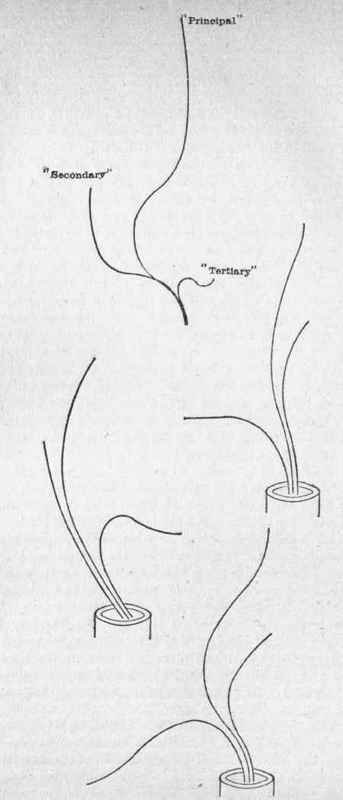
Trilineal Arrangement Of Stems
There is another style of design applied to a large class of flower arrangements, in which the Principal line of the composition has a horizontal, or almost horizontal, direction; the intention of such compositions being to suggest floral growth on the edges of cliffs or banks, when used in hanging vessels or vases placed on raised shelves.
The different lines have been spoken of as if existing in one vertical plane parallel to the spectator; but actually these lines have also directions of varying degrees forward or backward. In other words, the extreme points of these lines would require a solid and not a plane figure for their enclosure.
The various directions imparted to plants and branche of trees on the above principles are obtained first by a carefu selection of suitable material, then by twisting, bending, building together and fixing at the base, and lastly by means of cutting and clipping off defective or superfluous parts.
Flower arrangements are made sometimes with one species of tree or plant alone, and sometimes with a combination of two or more species. The use of many different kinds of flowers in one composition is opposed to the principles of the purer styles.
In arranging two or more species in one composition, variety must be sought by combining trees and plants. In a three-line composition the branches of a tree should never be 'supported' on both sides by a plant; nor should a plant be placed in the centre with a tree arrangement on either side. The two branches of the same kind must of necessity be used, but they should adjoin, not sandwich, the remaining one. For example, a composition with Irises (plant) in the centre and branches of Azalea (tree) and Camellia (tree) on either side would be defective. A correct composition would be one with a Plum branch (tree) in the centre, with a Pine branch (tree) on one side and Bamboo stem (plant) on the other. In cases of variety being obtained by land and water plants, this rule is sometimes violated.
The manipulation of different plants and tree-cuttings with the object of preserving their vitality needs special study. In some cases merely sharply cutting the extremity is sufficient to preserve the succulence; but with other material the charring of the end, or dipping in hot water to soften it, is common.
The Bamboo is particularly difficult to preserve. The inner divisions are generally removed, and the inside of the tube filled with spiced water or other stimulants. The object of these methods is to get the water to rise in the stem, so that the vitality of the bouquet may be preserved for days. Other means are resorted to in order to prevent the advanced blossoms falling off or dropping. In the case of some large and heavy flowers, invisible Bamboo spikes are employed to keep them erect. Salt is also applied at the base of certain blossoms, to keep the connection moist, and thus defer the shedding which often takes place owing to dryness.
The flower-vases are made of wood, porcelain, pottery, bronze, brass, iron, and basket-work, with wooden, earthenware, or tin receptacles inside for holding the water. They vary as much in form as in material, the most common standing vessels being broad and flat, or long-necked, opening out to a broad flat surface at the mouth; tall, narrow vases are also used. With the ordinary tall vase, whether of wide or narrow mouth, the height of the flowers is generally fixed as one and a half times that of the vase. In the case of broad, shallow receptacles, the height of the floral composition is made about one and a half times the breadth of the vessel. Vases for hooking on to walls and for suspending from a shelf or ceiling are also frequently used.
Having thus briefly quoted from the main principles of this Japanese art as given by Mr. Conder, I shall now make a few homely suggestions as to how they could be applied by any of us in England.
The following practical directions may be found useful to those who wish to try this system of flower arrangement at once with as little trouble and as little expense as possible:Go round your house and collect all the china, earthenware, and metal vessels that can be spared-even a kettle, if nothing else can be found, would do. Earthenware dog-troughs are specially adapted to water decorations; three-legged witch's cauldrons and common salt-jars also do very well; an ordinary earthenware flower-pot, with the hole at the bottom corked up, would lend itself to wedging purposes; and every house contains some ornamental pottery, bronze, brass, or silver vessels of a suitable kind. Glass cannot be used, as the pressure of the wedge would crack it; and for the same reason it is inadvisable to try to fix a wedge in fine or valuable china.
Continue to:


My Books

