


Suppositories, Bougies, And Pessaries
Description
This section is from the book "The Art Of Dispensing", by Peter MacEwan. See also: Calculation of Drug Dosages.
Suppositories, Bougies, And Pessaries
Dioscorides (a.d. 79), Galen (a.d. 131-200), and Avicenna (a.d. 980-1037) prescribed suppositories, and their prescriptions were still in vogue in the sixteenth century. Dioscorides also prescribed pessaries, which were more of the nature of tampons than soluble medicated pessaries. (See The Chemist and Druggist, 1891, 11. 385.) Suppositories and pessaries in those early days were made with such vehicles or excipients as (1) oils and fats, (2) gums and resins, and (3) honey. Suppositories frequently encased a piece of soft, old linen, which enabled the undissolved mass to be withdrawn. These now have their equivalent in the linted suppository and the Watson-Cheyne bougie. All these forms of medication dropped out of use, at least in good practice, during the eighteenth century. Pereira mentions suppositories (1849) in the following terms:
When the substances applied to the rectum are solid, we name them suppositories {suppositoria, from suppono, to put under). Formerly suppositories were conical, or cylindrical, like a candle, and of variable size- sometimes one or two inches long. They are now usually made globular and of small size. They are employed to evacuate the bowels ; to irrigate the rectum . . . but more commonly to act as local agents in affections of the rectum, bladder, uterus, prostate gland, urethra, etc.
This is interesting in view of the fact that the decade 1840-50 saw the renascence of the suppository, and that Pereira includes the bougie and pessary in the title. It was in 1840 that Dr. Osborne, a leading English practitioner, wrote about the value of suppositories in the London Medical Gazette. A few years later Sir James Y. Simpson began to prescribe pessaries, using a wax-and-lard basis; he published particulars in 1848. In 1850 Mr. A. B. Taylor, of Philadelphia, suggested cocoa-butter (oleum theobromatis) as a basis, and this has now become the most commonly employed fat for suppositories and pessaries. The various editions of the British Pharmacopoeia fairly reflect the progress of ideas in regard to the bases in use at the respective dates, but it is right to add that the earlier pharmacopceial formulae were considered to be behind date.
Suppositoria Morphiae 1864. | |
Hydrochlorate of morphia | 3gr. |
Sugar .... | 30gr. |
White wax ... | 30 gr. |
Lard .... | 30 gr. |
Suppositoria Acidi Tannici 1864. | |
Tannic acid . .. | 24 gr. |
Glycerine ... | 20 min. |
White wax . .. | 40 gr. |
Lard .... | 80 gr. |
Each of these was for twelve suppositories, and the mass was divided, solidified, and formed into cones each of which was dipped in a melted mixture of white wax 3 parts and lard 8 parts. This coating was abolished in the 1867 edition, and the mass made of benzoated lard 64 grains, white wax 20 grains, and oil of theobroma 90 grains for morphine suppositories. This was very good indeed as a basis, because one melted the wax and cocoa-butter together, mixed the medicament with the lard, and added the mixture to the melted portion, when a mass just fit for pouring was obtained. However, cocoa-butter alone was preferred generally, and the 1867 form was omitted in 1885. The Addendum to the 1867 B.P. recognised an old-fashioned formula, which was continued in the 1885, but was dropped in the 1898, edition. It was as follows, in the case of tannin:
1874. | 1885. | |
Tannic acid .............. | 36 gr. | 36 gr. |
Glycerine of starch....... | 50 gr. | 30 gr. |
Curd soap.................. | . 100 gr. | 100 gr. |
Starch ................... | . a sufficiency | a sufficiency |
For twelve suppositories. | ||
This was an unsuccessful attempt to prepare suppositories in the cold way. A gelatin basis was introduced into the 1898 Pharmacopoeia as a vehicle for glycerin, and the principle of adjusting the melting-point by the addition of white wax to cocoa-butter was recognised in the case of phenol suppositories. The United States Pharmacopoeia basis is cocoa-butter; no formulae are given, but it is recommended that suppositories should be made to weigh 1 gramme, pessaries 3 grammes, and urethral bougies 1 gramme.
The Shapes of suppositories, pessaries, and bougies conform more or less to that of a rifle-bullet. They are represented in the subjoined illustrations of hollow suppositories.
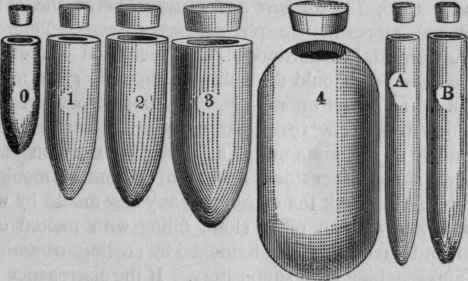
No. o is for children, and can also be used for the ear or nose. Nos. 1, 2, and 3 are for the rectum, the last being the size generally adopted for nutrient suppositories and for most pessaries (3j.); No. 4 is a pessary (3ij.); and a and b are the shapes and sizes for nasal bougies. Bougies vary in diameter from 1/12 to 1/6 inch, and are from 2 1/2 to 6 1/2 inches in length- a bougie 2 1/2 inches long and 1/8 inch in diameter weighs about 15 grains. The common size for urethral bougies is 4 inches long and 1/8 inch in diameter. Suppositories are usually 15 grains in weight- that is, they fill the same space as 15 grains of water- and are 1 inch long and 1/4 inch in diameter. Pessaries are now made oval as well as cylindrical, and rarely more than 1 drachm in weight. An improved shape for bougies and suppositories, consisting of a long and short cone, was suggested by Dr. Samuel G. Dixon, of Philadelphia, in 1888. Mr. Henry S. Wellcome, in a communication to the American Pharmaceutical Association in 1893, suggested a form as here indicated, now known as the 'Wellcome' shape, or 'enule.'
The Size of the official suppository was at one time vague, as the British Pharmacopoeia weight was in each case 15 grains, independent of the specific gravity of the mass. In January, 1896, The Chemist and Druggist asked the opinions of several representative pharmacists (Messrs. Peter Boa, A. W. Gerrard, W. Martindale, C. Symes, and Walter Hills) on the question, Should the bulk of a suppository be made up to that of 15 grains of water? They unanimously replied in the affirmative. The 1914 Pharmacopoeia prescribes the bulk to be made up to 1 gramme. The capacity of the moulds varies about a grain on either side of a 15-grain (1-gramme) mould. It is advisable to check the capacity of any new mould by wiping the interior with an oiled cloth, filling with melted cocoa-butter, and after the fat has hardened by cooling, trimming the tops and weighing each suppository. If the discrepancy is not more than a grain either way the mould may safely be used, as approximate accuracy is all that is expected in dispensing. Should the mould hold more than 15 grains of cocoa-butter, an additional quantity of the basis will be required in dispensing : it is customary to take ingredients as thirteen to the dozen to allow for waste.
The capacity of the mould for other bases- e.g., gelatin- should also be determined.
Continue to:


My Books

