


Henri II. And The Second Half Of The Sixteenth Century
Description
This section is from the book "French Furniture", by Andre Saglio. Also available from Amazon: French Furniture.
Henri II. And The Second Half Of The Sixteenth Century
THE style which it has become customary to call that of Henri II., because it was inaugurated in the reign of that monarch, who was the son of Francis I., lasted until the beginning of the seventeenth century - that is to say, during the successive occupation of the throne by the four last princes of the house of Valois. It was but the final nationalisation of principles brought from Italy, the outcome of the genius of the great sculptors, and still more of the great architects, of the Renaissance. Rarely in the history of art did so sudden a change take place, or at least appear to take place. As we have already seen, scarcely had the Italian style attained the dominating position in which it often was difficult to distinguish between French and foreign work, before it was in its turn driven out by the springing up of a new growth full of sap, which took root and bore fruit upon the dying beauty of its predecessor, much as does a rose upon the wild briar on to which it is grafted.
The men who rose up in response to the great thought movement of the Renaissance, encouraged by the royal patronage now accorded to art and to all intellectual work, were not likely to be content with servilely copying models originated by a people whose traditions and aesthetic requirements were quite unlike their own. The literary treasures of the antique world, dispersed after the fall of Constantinople and vulgarized by their reproduction through the newly discovered art of printing, would, of course, make a very different impression upon the creative imagination of Jean Cousin or Jean Goujon than they did on that of Donatello, Michael Angelo, Dello Delli or Andrea di Cosimo. With their chisel, these men created figures in stone which they presumed to be as classic as those shown them by Roman and Florentine artists, but which really, without resembling the old Latin models, were the expression of a truly French spirit. On the other hand, the architects of the first half of the sixteenth century - when the virile force of mediaeval times was, as it were, becoming deteriorated by anaemia and a predilection for the excessive elegance borrowed from across the frontier - also looked upon antique art from a different point of view than that of the Italians. They meant to copy but they really interpreted, and their hereditary sense of harmony and fitness led them to seek in the remembrance of long-banished buildings for models of furniture better adapted to the imagined surroundings of pagan emperors than were those of the Gothic period.
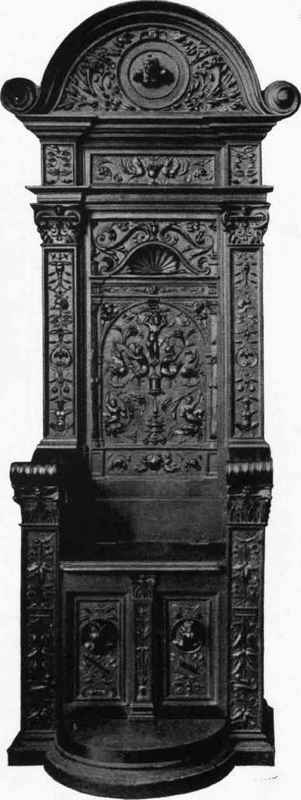
Plate X. CARVED WOOD CHAIR. XVI Century. Belonging to M. Chabriere-Arles.
The result of what may be called this great latent activity was the successive appearance of a series of albums containing engravings of designs for monuments, furniture, and decorative sculpture, all inspired by antique work, but for all that marked by a curious originality. It was to these the craftsmen of every part of France simultaneously resorted, to gather together the elements of the new style known as that of Henri II. To encourage each designer whilst retaining his own individuality, to modify the drawings given to suit his special needs, was indeed the chief aim of those who issued these publications - an aim frankly stated on the covers of some of them.
The authors of these collections of engravings were a Parisian named Jacques Androuet du Cerceau and a Burgundian called Hugues Sambin, and as they published the results of their researches in the towns in which they lived, Paris and Dijon, it is easy to divide the immense quantities of furniture produced in France in the second half of the sixteenth century into two schools, that of the Ile de France, and that of Burgundy, inspired by those two artists. This will obviate the necessity of attempting to describe the work of the various provinces, the classification of which would be of very doubtful value, as the books of engravings circulated everywhere were used by everybody, and give an almost identical appearance to the products of widely separated districts.
Little is known of the life of Androuet du Cerceau, except that he was born about 1510, and travelled as a young man in Italy, as is proved by some drawings preserved at Munich representing designs for St. Peter's at Rome and the Palazzo Cancelleria, copies of antique architecture, such as the Thermae of Diocletian, and reproductions of sketches by Bramante or his competitors, for that great architect was very much the fashion in Italy at that time. Du Cerceau did not hesitate later to issue to the public designs that were very evidently inspired by Bramante, giving to them antique titles, and thus leading his ignorant fellow countrymen to adopt them. His laudable intentions, however, go far to condone this piece of trickery, for, says his most appreciative biographer M. de Geymuller, it had a double purpose, "to make known the principles and forms of Italian art to all who adopted professions in France connected with the fine arts, or industrial art, as we should say nowadays, and to set his country free from the necessity of having recourse to foreign artists." He himself practised architecture, and amongst other buildings designed the Chateau of Montargis, belonging to Renee of Ferrara, and rebuilt the choir of the Church of the Madeleine in the same town.
After publishing a collection of engravings - the titles of which indicate clearly enough the professions of those for whom they were intended, such as the "Book of Mathematical Implements," "The Book of Architecture, with Fifty Designs for Different Buildings," "The Book of Designs for Country Houses," "The Most Excellent Buildings of France," Boundary Statues, Orders, Escutcheons, Designs for Trophies, Arabesques, etc. - he had an album printed containing 71 designs for furniture, including 21 cabinets or dressers, 24 tables, a choir-stall, 2 doors, 8 beds, 2 brackets, 1 panel, 1 overmantel, 3 terminals, and 8 socles or pedestals. The complicated prodigality of lines and ornaments in these designs is perfectly astonishing, and arouses a doubt as to whether it would be possible to reproduce them exactly; but this was evidently not the intention of the author, as proved by the works executed during and after his time. All he wished was that his book should be, so to speak, a mine of ideas, from which craftsmen might borrow architectural combinations and decorative motives, to be arranged according to their own individual taste.
Continue to:


My Books

