


113. Form Of Oilstones
Description
This section is from the book "Bench Work In Wood", by W. F. M. Goss. Also available from Amazon: Bench Work In Wood.
113. Form Of Oilstones
Form Of Oilstones. It is evident that if oilstones could be made round, and mounted like grindstones, they could be used more effectively than when only a small block is available. The reason they are not so mounted is that, in their native bed, the whetstone layers are traversed in every direction by veins of hard quartz, which, if allowed to enter into a finished stone, would destroy the cutting edge of any tool that might be applied to it. It is so uncommon to find large pieces of whetstone free from the quartz, that disks above 4" or 5" in diameter can be afforded only by those to whose work they are indispensable.
Fig. 133

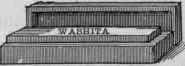
For bench purposes, Washita stones are about 1" X 2" x 7"; but no attempt is made to have them of any uniform size. Such a stone, when set into a block and provided with a cover to keep out the dust, is ready for use. See Fig. 134. Its surface should be kept as nearly as possible straight, in the direction of its length, and should never be hollowed across its breadth. When out of shape it must be trued.
Fig. 134
114. Slips of Washita stone whose cross-sections are round, square, triangular, etc., are supplied by the trade. A wedge-shaped slip is represented by Fig. 135; it is a form extremely useful to the bench-worker.
Fig. 135

115. To True an Oilstone, mix water with sharp sand until the mixture is thin enough to run. Apply a quantity of this to the surface of a flat board or plank, and, with the face that is to be trued in contact with the sand-covered board, move the stone about, frequently changing the direction of its motion. Under this treatment, the surface of the stone will be evened up rapidly. If the sand that is first applied becomes dull, it may be replaced by new.
Another, and usually a more convenient way, consists in substituting for the sand a sheet of sand-paper tacked over the edge of the board. Coarse paper may be used at first, and afterwards a finer grade selected for finishing the work.
Continue to:


My Books

