


Chapter I. Wood
Description
This section is from the book "Design and Construction in Wood", by William Noyes. Also available from Amazon: Design And Construction In Wood.
Chapter I. Wood
Next to food and clothing, wood is to man the most useful of substances, and there is no other single substance that has as great a variety of human uses. The prosperity of any nation is largely measured by its timber supply, and hence we see the extraordinary efforts now being made by progressive nations to conserve their forests. Today the lumber industry is the fourth largest industry in the United States, and any intelligent person can quickly make a list of scores of uses to which wood is put. Two-thirds of the people of the United States live in wooden houses and half of the population burn wood as fuel.
One of the most useful qualities of wood, namely its combustibility for fuel, also constitutes one of its most serious disadvantages; it is not fireproof. On the other hand, until it is actually burned thru, it retains its stiffness, a fact that is not true of hot steel. It is because of its destructibility by fire, as well as by insects and decay, that attempts are constantly made to find substitutes for it. But even in spite of the employment of such substitutes as cement and steel in constructive work, its use is constantly increasing.
Most of our paper is made of wood and practically all our furniture. Its great utility depends upon such qualities as its size, its strength, its lightness, its ease of working, its elasticity, its hardness and its beauty. When wood is to be used for building or other constructive work, then its size is of great importance, while in work requiring only small pieces, other qualities, such as hardness, or permanence of shape, are determining factors. The strength of wood is shown by the fact that a hickory bar will stand more pull than a wrought iron bar of equal length and weight, and a block of long-leaf pine will stand nearly as much crushing weight as a block of cast iron of equal height and weight. Hickory is so tough that no substitutes for it in wheel-spokes, handles and similar articles which have to stand constant blows, have as yet been found. The hardness and elasticity of such woods as oak and maple make them suitable for floors. Some wood, like spruce, that is both light and strong, is used for ladders and poles and canoe paddles.
For ease of working and permanence of shape, no wood compares with white pine, "the King of Woods," but unfortunately this species is now becoming scarce. For the making of furniture, two woods now hold supremacy, oak and mahogany. This is due partly to their beauty, but also to their strength. The oak is native; the mahogany is imported.
One of the most useful characteristics of wood is its ease of being joined together by nails, screws, glue, etc. Woods differ greatly in this respect, white pine, yellow poplar, and bass being very easy to nail, while oak, hickory, maple, and ash are difficult to nail without splitting. In general, the tough elastic woods split badly in nailing, while the soft brittle woods nail well. Hence, with some woods, before nailing, special precautions, like boring holes, have to be taken. On the other hand, woods like oak and maple, which are difficult to nail can be very securely joined together by means of screws. Certain woods, notable among which are mahogany and white pine, can be glued together with remarkable tenacity. This susceptibility to the cohesive action of glue is a most useful characteristic of all our common woods. Soft woods glue much better than hard woods.

Common Woods
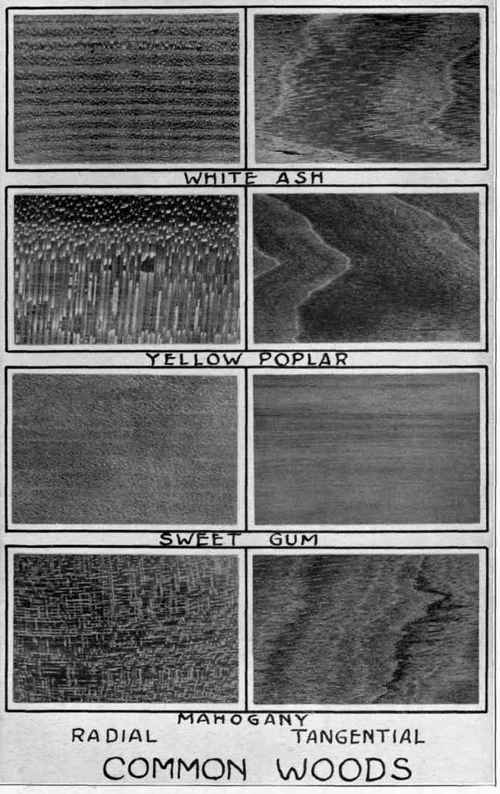
One quality, possessed by all wood, is of serious disadvantage, namely its sensitiveness to moisture. It shrinks when dry and swells when wet. This necessitates particular care in certain forms of construction and in methods of finishing. The shrinkage of wood is to be explained by its internal structure. Wood is composed of "cells" or fibers, which are long, slender tubes, thru which, during the life of the tree, the sap passes. The cells formed during the spring of each year grow large with thin walls, and those formed in the summer grow smaller with thick walls. A layer of spring wood and of summer wood together form an "annual ring" as seen in a cross-section of a log, or stripes, as seen in a longitudinal section. Running across these up-and-down cells and radiating out from the center of the tree are other cells called "pith rays," sometimes very large, as the "silver flakes" in oak (see frontispiece), sometimes very minute as in pine. They seive to bind the annual rings together and often, as in beech, sycamore and oak, add great beauty to the grain of the wood. Now wood shrinks because the walls of the cells which compose it become thinner as they dry. For some unknown reason wood cells do not become shorter, so that wood shrinks very little in length. This peculiarity is made use of in constructing doors and in other panel constructions.
Continue to:


My Books

