


1. Sulphonations. Part 2
Description
This section is from the book "The Fundamental Processes Of Dye Chemistry", by Dr. Hans Eduard Fierz-David. Also available from Amazon: The Fundamental Processes of Dye Chemistry.
1. Sulphonations. Part 2
The yield of "β-salt" is about 165 %, calculated on the weight of naphthalene taken, which corresponds in this case to a yield of 400-420 gms.
The mother-liquors can be worked up for Glauber's salt; it contains a little a-acid, together with resins and traces of β-acid.
The Melt of the sodium naphthalene sulphonate is one of the most important operations of applied organic chemistry. When one considers the very low price obtained for Naphthol it is hardly surprising that only quite a few factories manufacture this product. Cheap raw materials, such as coal, soda, and sulphuric acid, are, of course, essential. The waste heat from the melt pots must be utilized for drying the sodium salt and the Glauber's salt and sulphite produced as by-products, or the sulphurous acid must be recovered. A naphthol works that does not completely recover all its by-products is incapable of competing in the open market.
Fusion Pot (see Fig. 3). - On the laboratory scale the pot is best made of copper which, on account of its good conductivity, leads to a considerable saving of gas, and is therefore very cheap to work with. The same remarks that were made as to the moving parts of the apparatus in the case of the sulphonating vessel apply in the present case (p. 5). The high melting-point of the naphthol renders it necessary for the stirrer to scrape the entire surface of the vessel (see figure). The thermometer dips into a narrow copper tube which is brazed together at the bottom and filled with lubricating oil to a sufficient extent to ensure that at least 10 cm. of the thermometer is covered. Another good plan is to have the thermometer fitted into the hollow spindle of the stirrer.
60 gms. soda. 360 gms. NaCl.
Reaction:
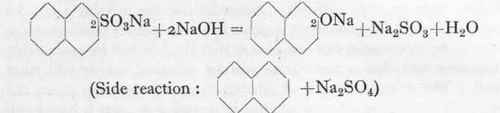
In order to ensure that the caustic soda and the sodium salt shall fuse together readily it is necessary that the latter be as finely powdered as possible. In the laboratory this is most conveniently effected by grinding the coarse salt in a powerful coffee mill.
The fusion pot is now placed directly on a small Fletcher burner and is charged with 200 gms. solid caustic soda, free from chlorate, in coarse lumps and 60 c.cs. water. If the caustic contains chlorate the yield will be diminished, and there is also very great risk of explosion. The caustic soda is melted to a clear liquid with the aid of a full flame and the temperature raised by degrees to 270o; the foaming which occurs during the heating ceases at that temperature. The powdered sodium salt is now added continuously, a spoonful at a time with stirring, the temperature being allowed to rise slowly to 2900. The dry sodium salt will be seen to disappear slowly, giving place to the dark, mobile, and glistening sodium naphtholate. Owing to the fluid character of the naphtholate it is now possible to add considerably more sodium salt than is given in most recipes. In the laboratory it is quite easy to work with 1 1/2 parts of sodium salt for each part of caustic soda used. On the works scale, given suitably constructed apparatus and adequate heating, e.g. with generator gas, it is possible to add 2.8 parts of salt to each part of caustic without any danger of burning, or of the mass becoming too thick. About half the β-salt (150 gms.) should have been added by the time the temperature has reached 2900. The temperature is now raised cautiously to 300o, then, when three-quarters of the salt (225 gms.) have been added, to 3050, and, finally, when it has all been added, to 318o. On no account must this latter temperature be exceeded. The melt attains by degrees a gritty consistency due to the separation of sodium sulphite, and the caustic soda is slowly displaced by the naphtholate. The whole melt is now kept for 15 minutes at 318° with continuous stirring, taking care that no overheating occurs. The complete process, from the time of the first addition, should occupy about one hour; if the salt be added too quickly some charring will occur with inevitable lessening of the yield.
200 gms. NaOH.
60 c.cs. H2O,

Fig. 3. - Fusion pot for β-naphthol.
The contents of the fusion pot are now poured on to a tin tray, As soon as it is cold the product is broken up and returned to the pot, together with 1/2 litre of water. On warming gently a considerable portion goes into solution, but a crust of sodium sulphite always remains behind; the solution is therefore poured off and fresh water added until the entire melt is in solution. It should not be necessary to use more than 2 litres for this purpose. The solutions are then mixed and heated to boiling over a Fletcher burner and treated with 50 % sulphuric acid until practically no reaction is given with thiazole paper; after cooling somewhat the liquid is sucked into a pre-warmed flask through a large porcelain filter-funnel ("Nutsche"). The volume of the neutral and filtered solution should be about 3 litres, and its colour not more than faint yellow.
This solution is now heated to boiling, and, whilst stirring well, sufficient 50 % sulphuric acid is added until litmus paper is strongly reddened. There will be no odour of sulphurous acid, as β-naphthol is insoluble in neutral sodium sulphite in presence of a little bisulphite, and therefore separates out, at first as an oil, which immediately solidifies. The precipitated substance may be filtered off after an hour or so without losing more than a trace of naphthol, using a cotton filter-cloth, and washing the product carefully with water. Before distillation the naphthol should be dried at a low temperature either in a vacuum drying chest or in a warm room; if it is heated too much it melts and sublimes.
300 gms. β-salt.
The yield of dried crude naphthol from 300 gms. β-salt is about 150 gms. (93 % pure), and of distilled product 135 gms. M.p. 122o.
Continue to:


My Books

