


Talk IX. From Three-Quarters To Full Swing
Description
This section is from the book "Intimate Golf Talks", by John Duncan Dunn. Also available from Amazon: Intimate golf talks.
Talk IX. From Three-Quarters To Full Swing
I have spoken of the importance to the golf beginner of perfecting the minor shots before attempting the full swing. This advice can't be repeated too often. First get the quarter swing down pat, then in turn the half, and follow that up with the three-quarter swing so that the right way becomes a habit; then the full swing in most cases will take care of itself. Some people think that the full swing is an entirely different movement from the quarter, half, and three-quarter shots. As a matter of fact, it is exactly the same - merely a continuation of the minor swings.
I have mentioned the necessity of practising the half swing until it has become perfect; until every move you make is correct without your giving a thought to what you are doing. When that happy moment has arrived, you can swing back to the three-quarter and perfect that in the same way (Figs. 43-44).
It happens that the three-quarter swing is the limit of some people's game. Their three-quarter and the shorter shots are often without a flaw, but when it comes to reaching back to the full swing they may not be able to quite get it. In such a case it is foolish for a man to spend a good part of a lifetime trying to acquire something that is beyond him. Life is too short.
It is far wiser to play fairly good golf with a three-quarter swing than poor golf with a full swing. The man who has perfected the three-quarter but can't quite master the full swing is up against this very situation. In most cases, this applies to men who have not taken up golf until they are over forty and who are without an athletic background.
Although the full swing is but a continuation of the three-quarter, I am going to take you to it by what may strike you as being a rather round-about method. However, it is an extremely effective one. This first step in getting the knack of the full swing is in the form of a simple practice exercise, somewhat along the lines of other exercises I have mentioned in our talks. I do not say that this particular exercise is necessary in order to acquire the full swing. But it simplifies matters, and golf at every stage should be kept down to the simplest possible terms.

Fig. 43
Top of the three-quarter swing

Fig. 44
Finish of the three-quarter swing
The first move in this exercise is to address the ball as you would for a quarter, half, or three-quarter swing. But instead of swinging the club back in the customary manner, bring it straight up to and over the right shoulder (Fig. 45). You will now imagine, if you can, that the club is a long handled mallet and that you wish to drive a peg into the ground with it. In the position you are now holding, the head of the club is hanging down over the shoulder; your hands on the grip of the club are in line with your chin. The position of the body remains just as in the address; body slightly bent, right shoulder depressed a little, left arm almost straight, right elbow down, head facing forward and feet firmly planted on the ground.

Fig. 45
Second position in the mallet exercise. Imagine you are about to drive a peg into the ground

Fig. 46
An instantaneous snapshot showing correct position at top of the swing
You are now in a position to drive the peg into the ground with an up and down swing of the arms. But if you wish to get any man-sized strokes out of the mallet, it is quite necessary that you get your body into the strokes. The entirely natural movement to do this would be to swing the arms to the right and at the same time pivot. This movement brings the shaft of the club (or mallet) across the back of your neck, although not quite touching it.
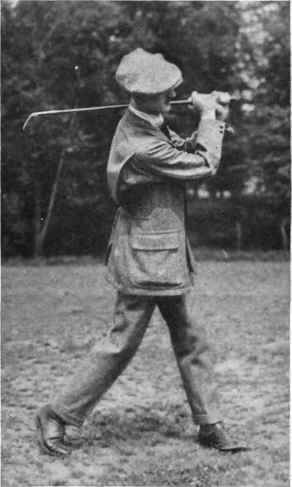
Fig. 47
The correct finish of a full iron shot
If you will now proceed to examine the pivot you have made with such entire naturalness, you will find that the left heel is off the ground, the left knee bent inward, right leg almost rigid, left arm almost straight, right elbow down, and your eyes are fixed upon the imaginary peg. And you may be surprised to learn that you are in almost perfect form for the top of the full golf swing (Fig. 46).
Continue to:


My Books

