


Talk VI. Some Golf Faults
Description
This section is from the book "Intimate Golf Talks", by John Duncan Dunn. Also available from Amazon: Intimate golf talks.
Talk VI. Some Golf Faults
The boy is a natural athlete. If you want to see an exhibition of golfing form that is practically flawless, ask a ten-year-old caddy boy to drive off. The chances are that he plays golf just as it should be played; naturally, without the slightest evidence of self-consciousness. Even though he drops the game for a few years he will never entirely forget how to play.
Grown men, taking up golf for the first time, are up against a harder proposition. Physically, they have got into all manner of bad ways since their boyhood days. Muscles have become set in unnatural directions. The golf instructor's job is to wipe out the years and make these grown men, boys again. If it happens that the beginner has gone in extensively for tennis or other sports, the task is often a comparatively simple one.
Natural aptitude for golf may come through having excelled at other ball games. As an example of this I might mention the case of an expert tennis player who came to me for golf instruction a short time ago. This man had never had a golf club in his hands before. Yet in only two or three lessons, his golf swing was nearly perfect. The tennis playing, of course, had kept his muscles and mental attitude toward a game just as they should be and gave him golf sense.
The man who has never gone in for other forms of sport has a distinctly harder row to hoe, when he takes up golf. But that is no reason why he shouldn't develop into as good a player as the other man, even though it does take him longer. If he keeps at it, he will arrive at golfing success.
"I know men who have tried to learn golf and given it up as impossible."
Anybody, I don't care who he is, can learn how to play golf. Of course, I don't mean that everybody can develop into an expert.

Fig. 27
Incorrect: rolling the forearms too soon
What I do say, however, is that anyone can become proficient enough so that he thoroughly enjoys playing golf. It is not a game which is impossible for some people, as is sometimes said.
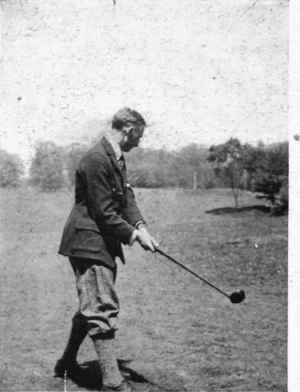
Fig. 28
Rolling the forearms correctly
Let the beginner who loses confidence and is about ready to give the game up, take this to heart. The name of this beginner's golfing faults may be legion; but that need not bother him. There is not a fault in the game of golf, which is not curable. His limit may be a half swing with a midiron, but even then that can be quite well worth while. It is a clever man who knows his limitations.

Fig. 29
It is a mistake to hold left arm doubled up and hands close to head as above
"What are some of the most common faults of beginners?"
The list would be a long one. Just to name a few, I might mention: rolling the forearms too soon on the back swing (Fig. 27); holding the left arm either doubled up (Fig. 29) or too rigid (Fig. 30) in the back swing; right elbow way up in the air at top of swing (Fig. 32); turning the left foot too soon; body off-balance (Fig. 32); raising up the body; head cocked over on left shoulder at top of swing instead of in dead centre. So it goes.

Fig. 30
Left arm position shown above is too straight and rigid
But I repeat, there is not one of these faults that cannot be cured. In some cases it takes longer than others. Much depends upon the interest and perseverance of the aspiring golfer; a great deal upon the instructor. A boy can learn by imitation, but a grown man analyzes things and has to know the reasons for making certain motions in specified ways. Just as soon as he understands the whys and wherefores of these motions, he goes ahead and performs them more naturally.
So it's a good deal up to the beginner to fire away with questions; the more the merrier. Besides this, it's a sign that he is genuinely interested, all of which puts the instructor upon his mettle, and he in turn becomes interested in making an especially superior golfer out of that particular pupil. Don't do anything without a good reason, because otherwise you will do it against your will.
"Don't the methods of some of the various golf instructors vary ?"
Unfortunately, they do. In fact, I know of certain cases where beginners have been taught absolutely false golf. You've no idea how great a handicap this is to a beginner. The day usually comes when he changes instructors. But by that time, the damage will have been done; the wrong way has become a habit. He is a much harder case for the new instructor than though he had never had a club in his hand.
So you will see that it is highly important that a beginner start right. An acquired fault is the hardest kind of a one to get rid of.
"How is a beginner to know correct golfing form?"
I'll lead up to that gradually. First, let me say that golf is a game which has been played for more than three hundred years by people of the leisure class - people who haven't done much of anything else except play golf. All of which represents a good many generations of life-long study of the game. With such a solid background, it is reasonable to suppose that there are certain golfing motions in the game, as it is played to-day, about which you can say, "This is the correct way, any other way is wrong."
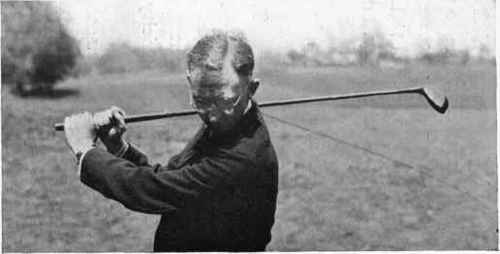
Fig. 31
Correct position of the left arm. It should be neither too straight nor too much bent
This rule of course does not apply to some few personal peculiarities in the game of some well known present day players. The grip, stance, and method of putting may differ slightly among leading players. Suit yourself pretty much how you go about them, remembering not to copy the eccentricity of an individual.
I've spoken before about the essentials and non-essentials in the game. A great many people get the two mixed up. There is a tendency to be up to date; on the lookout for the most recent stunt that some leading golfer has made popular. Perhaps it is a new way of gripping the club, such as the Vardon grip. In which case it is a non-essential. So, why copy it? Rather make a study of the parts of that particular player's game which have the three hundred year background; in other words, the essentials.
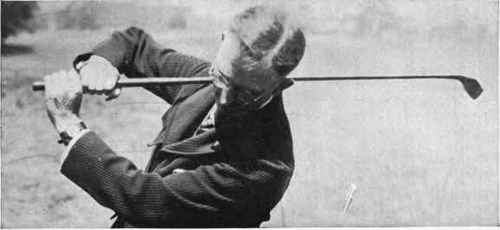
Fig. 32
Right arm is way up too far and body is off balance
I believe in copying the successful ones in golf, and in life for that matter. But I think it only common sense for one to confine this to the elements that have made them successful. If you go too far, you are liable to get muddled up and lose your sense of proportion.
I have here a collection of photos of some of the world's leading golfers in action. After you have studied these awhile you will find that there are not so many different kinds of golf form as you may have thought. In fact there is only one kind; and you will see it in every one of those pictures. The essentials of the swing are the same in every case. It is only in the non-essentials that they differ.
Study those photos carefully. Note the exact position of Vardon's heel in relation to his back swing. See whether his arm is rigidly stiff, only partially so, or doubled up.
Clearly, it is only partly stiff. Then the next time some one tells you to play with a perfectly rigid arm, flash Vardon's photo on him.
Continue to:


My Books

