


Talk XI. Take Care Of Your Hands
Description
This section is from the book "Intimate Golf Talks", by John Duncan Dunn. Also available from Amazon: Intimate golf talks.
Talk XI. Take Care Of Your Hands
The man who expects to play a good round of golf must first of all be in prime condition. This applies either to his physical or mental make-up, usually a combination of the two. A heavy lunch immediately before a round, for example, is not conducive to the best play. Your wits must be keenly alive every minute in golf and if you feel the least bit loggy it is difficult to keep them so.
Even though you have a good fund of energy, it is a mistake to use a lot of it in getting to the links. Now and then a pupil who has an appointment with me for a golf lesson finds that he is a minute or two late and rushes in all out of breath. As a matter of fact I would prefer that he did not come at all than in that condition. He will be in no shape to get the most out of the lesson until he has rested for a time and become normal again.
In the same way, it is a mistake to rush through a round of golf, as though you were catching the last train home. Many a man at the end of such a round looks as though he had been through a football game. It is safe to say that his game has suffered more than he has. Golf is a game in which there is no intention of roughness either on your opponent or yourself. If you treat yourself the least bit roughly, your game will suffer in consequence.
This brings us to the care of the hands. Few people realize how important it is that the hands be without a scratch or blemish. Even a ring worn on your finger is detrimental to good golf. But it is the common garden variety of blister that is probably the most usual offender so far as the hands are concerned.
You may consider a blister or a scratch of small importance. In a football game, of course, it wouldn't make any difference with your game. But you must remember that golf is an entirely different sort of sport. Here is a game so keenly mental that even the rustling of a piece of paper may turn a prospective long drive into a disappointing foozle. What then of the worrisome blister on the driving hand? Simply that it is practically out of the question for one thoroughly to concentrate as long as it is there. And without thorough concentration one can never hope to play good golf.
Some golfers seem to be a bit proud of a row of blisters. They are nothing to be proud of. In fact, they serve only as one of the best known means of keeping the score high. These golfers may not realize it, but they can hold those blisters directly responsible for having lost them a good many holes. Probably nine golfers out of ten fail to appreciate fully just how highly keyed a game it is they are playing.
Even a single small blister is one of the greatest of handicaps to a man's game. It doesn't actually have to give you pain to throw your game off. The subconscious thought that it is there is often enough. Such a small thing in some cases can be more disastrous to one's game than even a bad case of indigestion.
There is no reason in the world why a golfer should have blisters. If he realized how much they harmed his game he wouldn't grow them in the first place. This simply represents taking some means of prevention. In other words, wear gloves. At any rate, wear them until your hands have become so hardened that they can fairly well take care of themselves. Even though a man doesn't keep them on all season he should in all cases wear them in the early part when the hands are soft.
This applies equally to the man just taking up golf, whenever he starts. You may think that the hands will fail to become hardened when wearing gloves. As a matter of fact they will become hardened just about as fast with gloves as without them. The only difference is that in one case they will come out with blisters and in the other without. Some men don't like to wear gloves playing golf because they think gloves seem effeminate. Of course such talk as this is all poppycock.
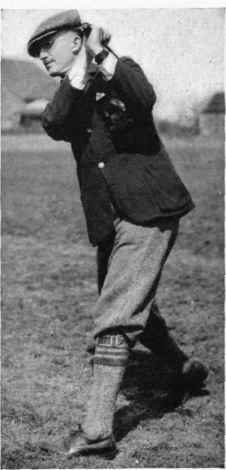
Fig. 52
It is wholly natural golf when all muscles of the body from toes to eyes move together in one direction
The manner in which one grips the club often has much to do with the development of blisters. You will more frequently find blisters on the hands of beginners than in the case of men who have played golf a good deal. The reason for this lies in the fact that the beginner, instead of relaxing properly, usually grips the club as though it were the proverbial straw of the drowning man.
The thickness of the club shaft also has something to do with this. A grip of narrow diameter is often more likely to give one blisters than one of larger diameter. In the case where the thickness is not so great one instinctively grips harder to get a purchase upon the club (Fig. 53).
So much for blisters. Now for trouble that may come from holding the left hand too high up the shaft. If you will turn your left hand upward and feel along the side of the palm in line with the left hand's small forefinger you may or may not find a little soreness there.
If you fail to find any tender spot in the palm this means that you are probably in the habit of gripping the club with your left hand at about the right position on the shaft. This proper position is just below the top string binding on the leather (Fig. 16).
However, if there is a soreness in the palm it means that when you grip the club, you allow your left hand to wander up above the top of the shaft. Any one who does this is letting himself in for a lot of trouble. It happens that there is a very delicate bone in the outer edge of the palm. If the top of the shaft comes into contact with this, the bone becomes very much irritated, and you are likely to have a bad siege of it. I've known men who have been out of the game entirely for six months at a time just because of this. So be sure to keep your hand below the top string binding.
I do not favor the overlapping grip. I prefer the natural grip. One reason for this is that the overlapping is likely to knock a man's hands out of kilter. In the overlapping grip, the small finger of the right hand comes into contact with the forefinger of the left. As a result, friction is set up and very often you find a mean sore on the knuckle of this left forefinger. A sore of this sort is disconcerting to one's game. If you attend a tournament you will probably be able to recognize the men who use the overlapping grip by rings of tape around their forefingers.

Fig. 53
The grip of this club shaft is of generous diameter. One is not tempted to grip hard in order to get a purchase
Speaking of tape, if you have reason to use it, you might as well use it right. Many people wind a piece of tape around a sore finger just as though they were tying up a bundle. If you wish the sore to heal - and you wouldn't bother with tape at all if you didn't - treat it decently. Never should one allow the sticky side of the tape to come into contact with the sore. Wind first with the smooth side next to the sore. After that you can reverse it and wind with the sticky part underneath.
Continue to:


My Books

