


Combined Kites. Continued
Description
This section is from the book "Kitecraft And Kite Tournaments", by Charles M. Miller. Also available from Amazon: Kitecraft And Kite Tournaments.
Combined Kites. Continued
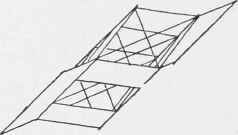
Fig. 95.
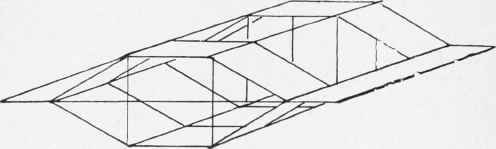
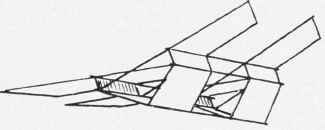

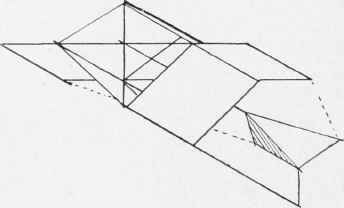
Figs. 96, 97, 98, 99.

Fig. 100.

Fig. 101.

Fig. 102.

Fig. 103.
Another way of flying kites in tandem is to fasten all kites directly to the one kite line, the line passing thru each kite after the the first. This method however requires a helper for each kite and they are placed closer together. At one of the Los Angeles Tournaments, two boys had a beautiful team of green and white kites arranged in the second series of tandem. The kites were of the triangular box and house kite order, Fig. 89, were six feet and nine feet tall, and were nine in number. There was insufficient breeze to fly them well, but it was great sport for thirty or forty boys to run with the kite line. They were strong enough to lift up a large man. The heaviest pull that was registered was a little over two hundred pounds, but in a good breeze they would have pulled over four hundred. I would like to show you a picture of them, but I failed to get one.

Fig. 104.
Fig. 105.
In the second series of tandems, while all kites are attached to the same line directly, there is an individual bridle for each kite, but in the third series we have a sort of harness that combines all kites together, so that if one tips forward, all tip forward, and vice versa. It will be seen that in Figs. 107 and 108 where a number of tailless kites are arranged in a regular series, that there is a complete harness running from the larger kite as a head, to the banner floating out at the rear. Four cords are attached, one at the top, another at the bottom, and one at each side. The distances between all points are the same, so when the head tips forward, the second kite has a similar inclination to the breeze, and so on thruout the whole series.
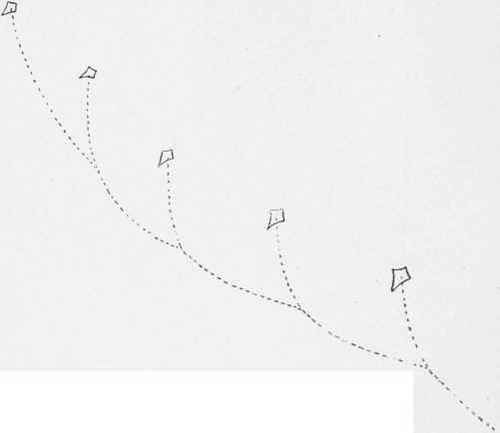
Fig. 106.
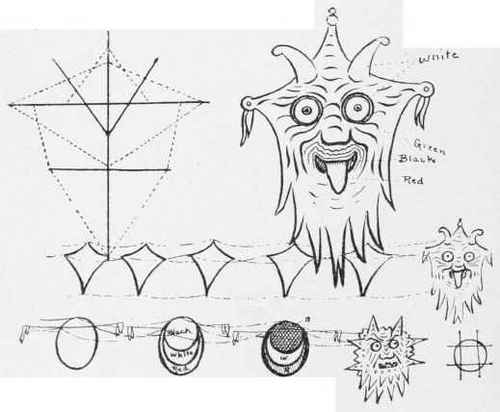
Fig. 107.

Fig. 10S.
The bridle is attached at the four points at the head, so attached as to give a good flying inclination. This series is called a "Tailless Dragon Kite" and flies well and makes a fine appearance in the air.
The tailless dragon can be made more ornamental and seem more connected, by extending the spine above the kite as in the head, a string with a feather edge of tissue paper being festooned from the top of one kite in the series to the next. At the bottom of each kite some streamers of tissue paper would help in the same manner, Fig. 109. The regular Chinese centipede kite, Fig, 110, is not so difficult now that we have harnessed the tailless dragon.

Fig. 109.

Fig. 110.

Fig. 112.

Fig. 111.
The Chinese say there should never be more than three strings to bridle or harness; this bridle has two strings to the head of the dragon, and three strings to the harness. The harness consists of the three strings running from one end of the kite to the other. The Chinese dragon kite usually, if not always, has circular disks for the body of the monster. Fig. 111 shows a beautiful kite hung on the wall for decorative purposes and shows the design on the individual sections, while Fig. 112 shows the same kite held by boys on the lawn. The lighter portion on the disk is green with gilt scales, while the darker portion is scarlet. The head is all colors, with red mouth, white teeth, eyes that revolve with little mirrors thereon to flash the sunlight. The framework for the head is shown in Fig. 113. While the framework for each circular disk, Fig. 114, is just a band of bamboo, with a light strip of bamboo to which the peacock feathers are attached as balancers, the disks are covered with Chinese paper and decorated. The disks are 10" and the balancer sticks 30". The feathers are lashed to the balancer sticks. The disks are 12" apart. The last disk has streamers of ribbon or tissue paper. This kite flies well and sways about like an immense brightly colored caterpillar up in the air.
The dragon kite, Fig. 115, was very beautiful and flew high in the air. The colors were pink and white. Instead of feathers for balancers, tufts of tissue paper were used. A special balancer was used for the whole kite in the form of a hollow ball. Small reed or bamboo was used for the skeleton, and this was covered with tissue paper. See it hanging below the kites head in the picture. The various sections are covered with different colored papers. The heads differ, but otherwise the kites are quite similar in construction.

Fig. 113.

Fig. 114.
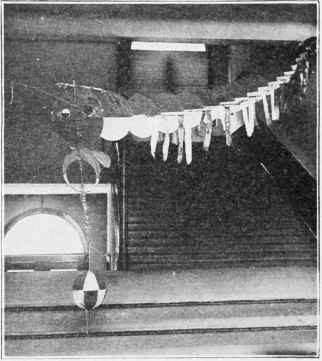
Fig. 115.
Continue to:


My Books

